Introduction
This section provides an introduction to the ChargePoint® Express Plus Power Block and Power Link 2000.
Express Plus Components
Express Plus is a scalable DC fast charging platform that is based on the modular building blocks outlined below.

-
Power Module: Self-contained AC to DC power conversion system that operates an output of between 100 and 1000 V and delivers up to 40 kW of power.
-
Power Block: Power cabinet that houses up to five Power Modules and supplies DC output power to Power Link 2000s. Each Power Block can output up to 200 kW of power.
-
Power Link 2000: Dispenser that delivers DC power to EVs through flexible, lightweight charging cables equipped with industry standard connectors such as CCS1, CCS2, CHAdeMO, MCS, and NACS
 North American Charging Standard. The Power Link 2000 can accommodate up to two charging cables to charge two electric vehicles simultaneously or sequentially. Built-in cellular networking enables remote management via the ChargePoint Platform Dashboard.
Express Plus System Overview
Express Plus consists of the following components:
Power Block
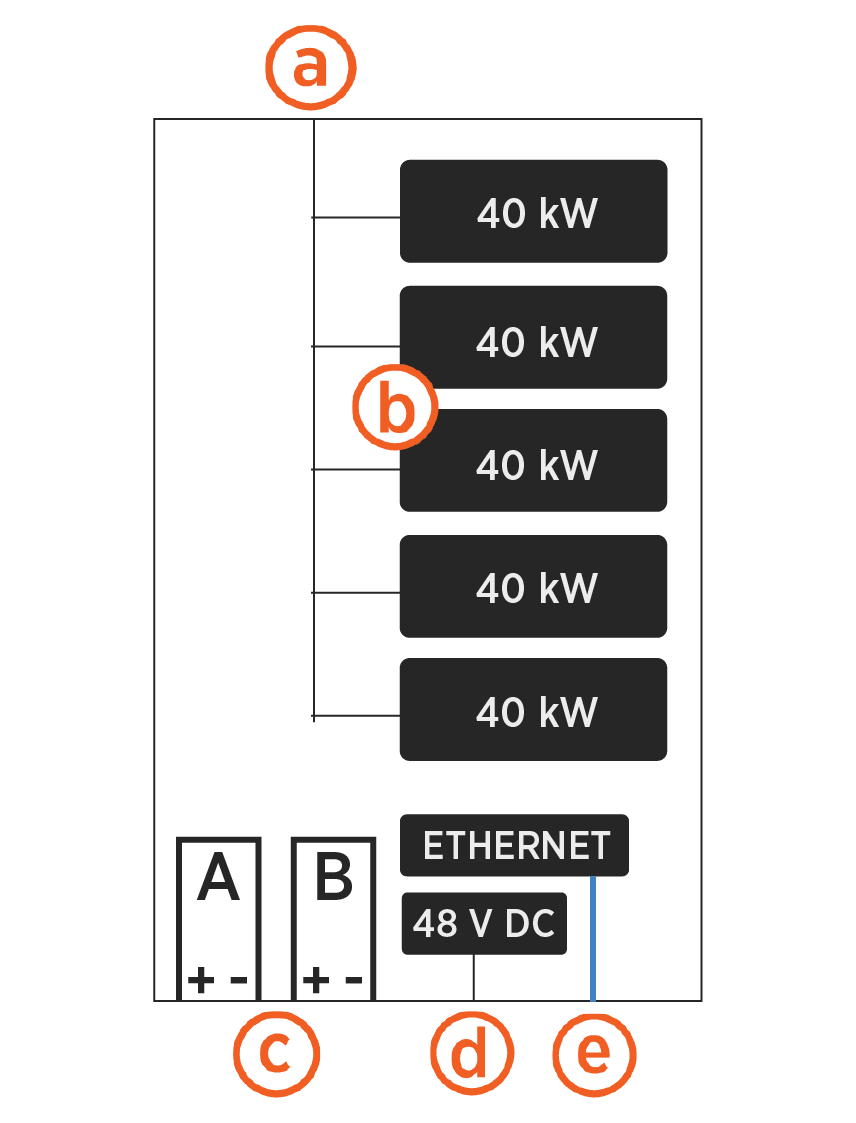
Power Block block diagram:
-
Three phase AC power input
-
Configurable with up to five 40 kW Power Modules for a maximum total output of 200 kW
-
Two available HV DC
High Voltage Direct Current power outputs (A and B) -
48 V DC power output
-
Ethernet output
The Power Block is an enclosure structured with an upper and lower enclosure, stacked on a pedestal:

-
Upper enclosure: Auxiliary power supply and temperature management components
-
Lower enclosure: Bay for Power Modules and bus bars to land all input and output cables
-
Pedestal: Secures the Power Block and provides access for either stub-up or surface mount installations on a concrete pad
Power Link 2000
Power Link 2000 block diagram:

-
Single or dual HV DC
High Voltage Direct Current power paths (A and B) -
48 V DC power input
-
Ethernet input
-
Single or dual HV DC
High Voltage Direct Current charging cable outputs (L and R) -
48 V DC power output
-
Ethernet output
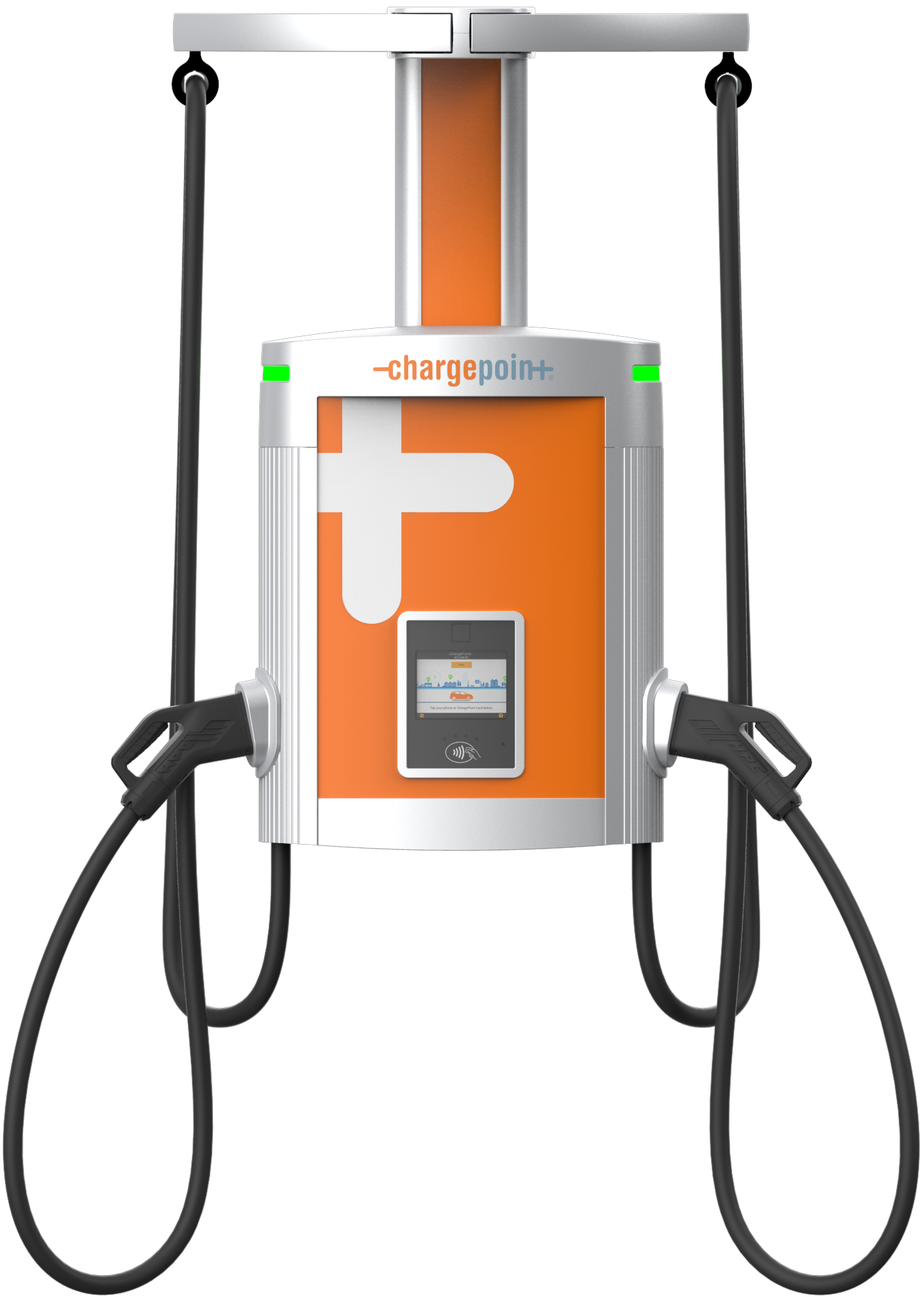
The Power Link 2000 is a vertical enclosure that is available in the following variants:
-
Pedestal-Mount Power Link 2000
This enclosure is designed for mount on a concrete ground surface and is equipped with charging cable holsters and an interactive display. The enclosure is available with single or dual outputs.

-
Wall-Mount Power Link 2000
This enclosure is designed for mount on a wall or other vertical-standing structure. It is equipped with cable holsters and an interactive display. The enclosure is available with single or dual outputs.
-
Overhead-Mount Power Link 2000
This enclosure is designed for mount on a wall or overhead structure (such as on a gantry or from a ceiling structure). The enclosure is available with single or dual outputs.

Power Block to Power Link 2000 Architectures
Express Plus is a highly modular system wherein Power Blocks and Power Link 2000s can be interconnected in many configurations to meet various charging needs, from simultaneous charging of two vehicles at up to 600 kW by a single station to sequential charging of up to 12 vehicles.
The DC output of the Power Block is the DC input of the Power Link 2000. Each Power Block has two HV DC High Voltage Direct Current outputs that can be fed to a single Power Link 2000 or to two different Power Link 2000s. A simplified block diagram of a single Power Block connected to two Power Link 2000s is shown below. The Power Block also feeds 48 V DC power and Ethernet connectivity to the Power Link 2000s.

In turn, the Power Link 2000 accepts high voltage DC input from up to six Power Blocks. A simplified block diagram of a Power Link 2000 powered by two Power Blocks is shown below.

The high voltage DC output, Ethernet, and 48 V DC power output from Power Block(s) can be connected from Power Link 2000 to Power Link 2000, enabling higher port counts in specific sequential charging configurations.

For full specifications and certifications, refer to the Express Plus Datasheet at ChargePoint Product Reference Documentation.
Power Block and Pedestal-Mount Power Link 2000 Configurations
The Power Block and pedestal-mount Power Link 2000 offers several configuration and installation options, described below.
Charging Cables
Depending on the charging speed and connectors required, pedestal-mount Power Link 2000s can be installed with one or two liquid-cooled cables (LCC Liquid Cooled Cable) or non-liquid-cooled cables (non-LCC Liquid Cooled Cable). The pedestal-mount Power Link 2000 with LCC Liquid Cooled Cable comes with a liquid cooling system attached to the back of the enclosure.
| Single or Dual LCC Liquid Cooled Cable |
Single or Dual non-LCC Liquid Cooled Cable |
|---|---|
|
|
|

Cable Management Kit (CMK)
Depending on the required cable reach, the pedestal-mount Power Link 2000 can be installed with a standard CMK Cable Management Kit to manage standard length (5.8 m or 19 ft) charging cables, or with a tall CMK Cable Management Kit or overhead CMK Cable Management Kit to manage medium length (7.6 m or 25 ft) charging cables.
| Standard CMK Cable Management Kit |
Tall CMK Cable Management Kit |
Overhead CMK Cable Management Kit |
|---|---|---|
|
|
||

Wire Entry
-
Stub-up entry: Wires can enter pedestal-mount Power Link 2000s and Power Blocks through the bottom of the enclosures via conduits or armored cables laid underground.
-
Surface entry: At sites where the wires cannot be laid underground, they can enter into pedestal-mount Power Link 2000s and Power Blocks through the rear side of the enclosures via conduits or armored cables laid above ground.
Wall and Overhead-Mount Power Link 2000 Configurations
The wall- and overhead-mount Power Link 2000 offers several configuration and installation options, described below.
Charging Cables
Wall and overhead-mount Power Link 2000s can be installed with one or two non-liquid cooled cables (non-LCC Liquid Cooled Cable). They do not support liquid-cooled cables (LCC Liquid Cooled Cable).
| Single Non-LCC Liquid Cooled Cable |
Dual Non-LCC Liquid Cooled Cable |
|---|

Cable Management Kit (CMK)
-
Wall-Mount:
A wall-mount Power Link 2000 can be installed with a standard CMK
Cable Management Kit to manage standard length (5.8 m or 19 ft) charging cables or with a tall CMK Cable Management Kit to manage medium length (7.6 m or 25 ft) charging cables.Standard CMK Cable Management Kit Tall CMK Cable Management Kit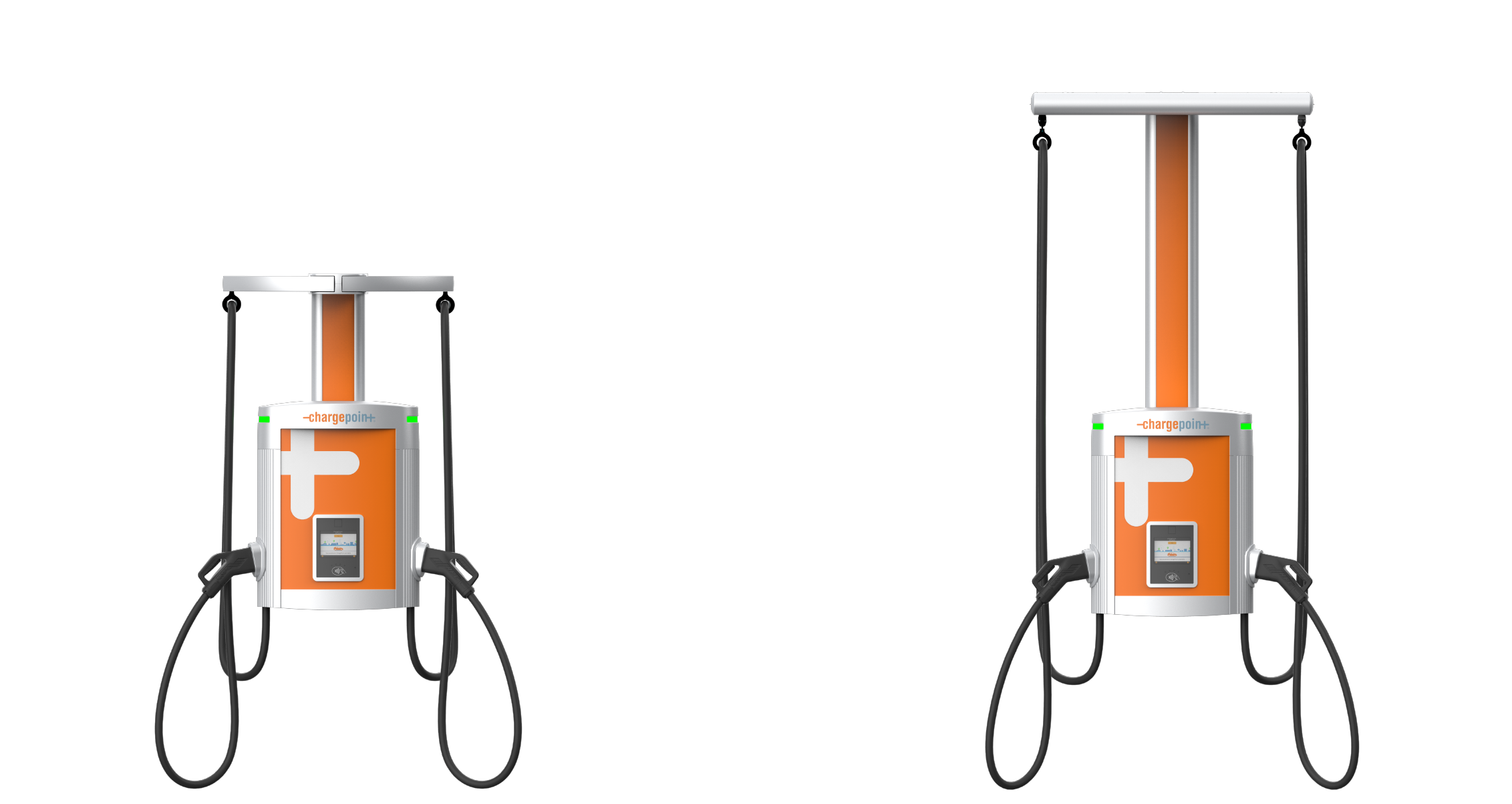
-
Overhead-Mount:
An overhead-mount Power Link 2000 can be installed with an overhead CMK
Cable Management Kit to manage medium length (7.6 m or 25 ft) charging cables.Overhead CMK
Cable Management Kit

Wire Entry
The wires enter into wall and overhead-mount Power Link 2000 from the bottom side, through conduits or armored cables laid above ground.
Express Plus Guides
Access ChargePoint documents at ChargePoint Product Reference Documentation.
|
Document |
Content |
Primary Audiences |
|
Datasheet |
Full station specifications |
Site designer, installer, and station owner |
|
Site Design Guide |
Civil, mechanical, and electrical guidelines to scope and construct the site |
Site designer or engineer of record |
|
Concrete Mounting Template Guide |
Instructions to embed the charging station template in a concrete pad with anchor bolts and conduit placement (these may also be included in the Site Design Guide) |
Site construction contractor |
|
Surface Conduit Entry Kit Guide |
Instructions for sites where conduit cannot be run underground |
Installer |
|
Construction Signoff Form |
Checklists used by contractors to ensure the site is correctly completed and ready for product installation |
Site construction contractor |
|
Installation Guide |
Anchoring, wiring, and powering on |
Installer |
|
Operation and Maintenance Guide |
Operation and preventive maintenance information |
Station owner, facility manager, and technician |
|
Service Guide |
Component replacement procedures, including optional components |
Service technician |
|
Declaration of Conformity |
Statement of conformity with directives |
Purchasers and public |