Energy Management Benefits
ChargePoint’s Energy Management offers significant benefits, making it essential for efficient EV charging. These include one-time cost savings, recurring cost savings, and other operational and environmental advantages.
One-Time Cost Savings
Figure 1: Static Load Management
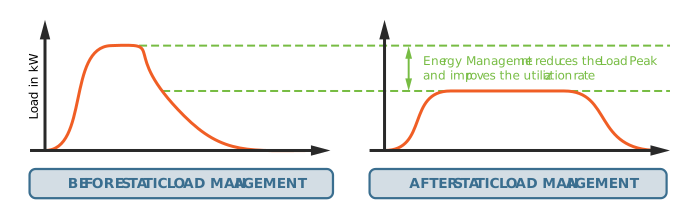
EMS allows you to install more chargers (Oversubscription or Breaker Overload Protection) with less or without expensive and time consuming upgrades to your electrical system, saving significant upfront costs.
-
Avoidance/Reduction of Grid Connection Extension: Upgrading grid connections (e.g., transformers, transmission lines, civil work) can cost $10,000–$100,000 or more and take 12–18 months due to permitting and construction delays, if even possible. EMS reduces or eliminates the need for these upgrades by managing power within existing limits.
-
Avoidance/Reduction of Local Electrical System Extension: Expanding local electrical infrastructure (e.g., additional breakers, wiring, or panels) can also cost $10,000–$100,000. EMS optimizes power distribution, allowing more chargers without costly modifications. Energy Management prevents overloading circuits, breakers and transformers, avoiding tripped breakers and costly repairs.
Recurring Cost Savings
EMS reduces ongoing energy costs by reducing power peaks (Peak Shaving) and can shift charging to lower-cost periods with time variant Limits (Time of Use - feature):
Peak Shaving or Demand Charge Reduction: Utilities often charge for peak power usage (demand charges), calculated over 15-minute intervals (~10-30 $/kW/month - both for North America and Europe). EMS can reduce peak demand by 30–70% (typically 50% but dependent on the use-case), saving significant costs per port:
Example-site with 4x100 kW DC ports and 10x10kW AC ports = 500kW in total. If all ports are used at the same time the site needs to be prepared to deliver 500 KW and the 500 Power Peak has to be paid monthly with the demand charges 500kW * 20$/kW = 10,000 $ per month of demand charges. By setting an EMS limit of 250 KW the demand charges will be cut at 5000 $ per month saving each month 5000 $ or in total 60,000 $ per year. Of course, it should also be noted that simultaneous charging at all charging points will only be possible at reduced power. However, this is only expected to occur rarely. But as soon as this happens even once a month, these cost savings can be expected.
Other Benefits
Ensure Operational Readiness: Energy Management as part of our Fleet Operationssolution guarantees EVs are charged when needed, critical for fleets like buses or delivery vans.
Meet Legislative Requirements: Complies with regional grid stability standards and grid operator requests.
Simplify Installation: Reduces the complexity of electrical setups, saving time and resources.
Grid Optimization: Supports Demand Response to reduce load during peak grid times, enhancing stability.
Energy Management facilitates the integration of battery electric vehicles into the energy system and thus the transition to sustainable mobility.
Additional Features related to Energy Management
| Basic features | Short Description | Explanation |
|---|---|---|
|
Power Select or Fixed power derating |
Permanent current limitation |
Sets a fixed maximum current (in Amperes, A) for a station or port to match breaker or wiring capacity. Why use it: Enables stations to be provisioned on smaller circuits without exceeding the rated capacity and, thus avoids costly upgrades. |
|
Circuit Sharing (also called Cablesharing) |
Station internal power sharing for ChargePoint dual-port AC stations as CT4000, CP6000 and ??? |
Circuit Sharing lets a dual-port AC charging station (e.g., CT4000, CP6000) use a single electrical circuit with limited capacity, managing power distribution internally to avoid overloading. How it works: One port can use the full circuit capacity (e.g., 32 A for a 40 A circuit). If both ports are used, power splits evenly (e.g., 20 A each). Why use it: Reduces installation costs by sharing one circuit, avoiding extra wiring or breakers. How to set it up: Configured via jumper settings on the station during installation. |
|
Delayed charging scheduling |
Binary charging schedule to enable/disable charging for certain periods on a weekly schedule (e.g. price based) |
What it is: Schedules the time when charging is possible and blocks charging otherwise, e.g. during high cost periods (only for CPF50 stations) How it works: Vehicle can be plugged in at any time, but charging will be deferred until a time when it is permitted
How to set it up: CPHxx configured in mobile app by end user, can be set automatically when selecting a utility TOU rate plan. CPFxx configured in Stations > Scheduled Charging |
|
CPE250/280 Pairing |
Hardware feature to combine the power output of two chargers to one port to increase charging power. |
What it is: Paired CPE250/280s share the four (total) Power Modules among the two CPE250s, steering power to the vehicles that need it How it works: Power can be shared statically (a fixed allocation of power modules) or dynamically via Equal Share or First Come First Served to match customer’s needs. E.g., a single vehicle can charge at a full 125 kW; when a second is plugged in, they each get 62.5 kW How to set it up: It is a hardware feature that must be ordered during the initial configuration and will be installed alongside the station installation. |
