Site Design Guidelines
Initial Site Guidelines
Designing the electrical infrastructure with both current and future EV Electric Vehicle charging needs in mind helps prevent costly upgrades as demand increases.
Conduct a site assessment to determine conduit and wiring requirements from the electrical panel to the planned parking spots. Also, check cellular signal strength and identify optimal locations for any necessary signal booster equipment.
If you purchased ChargePoint station installation services, but you are using your own contractor for site preparation and electrical work, you must complete and submit the Construction Signoff Form (CSF). This form allows ChargePoint to confirm the site readiness and ensure the work meets electrical code and ChargePoint standards before the final station installation or commissioning can occur.
Electrical Requirements
At a minimum, each AC charging station requires the following:
-
Single-phase or three-phase circuits: 10 A to 40 A
-
A circuit breaker at the electrical panel with the recommended capacity
-
Conductor wiring and circuit protection sized in accordance with all applicable codes
Additional Electrical Considerations
-
Flex Plus charging stations are AC electrical vehicle supply equipment (EVSE
Electric Vehicle Supply Equipment) and are permanently connected to AC electrical infrastructures. -
Evaluate existing electrical infrastructure to determine if the existing utility service and electrical panel capacity is sufficient.
-
Ensure appropriate electrical wiring, over current circuit protection, and metering, if required, is in place.
-
Identify costs for any necessary upgrades and/or a new dedicated electrical panel.
-
ChargePoint recommends using a licensed electrician to evaluate available capacity and identify any upgrades that may be required.
-
If a dedicated EV
Electric Vehicle electrical panel is required, choose a panel location in close proximity to the charging stations. -
Determine raceway or conduit runs for electrical wiring from the electrical panel.
Charging Station Placement
To help control costs, place stations as close as possible to existing electrical infrastructure. This reduces long conduit and wire runs and may eliminate the need for trenching.
Wall-mounted stations must be installed on flat walls rated for the weight of the station.
Pedestal mounted stations must be installed on level concrete bases rated for the weight of the station. Asphalt cannot support the full weight of the station.
Failure to install the station on a suitable surface may cause the station to tip over, resulting in death, personal injury, or property damage.
Layout Considerations
-
Identify station locations for EV
Electric Vehicle charging spots. -
Flex Plus charging stations can be installed either indoors or outdoors.
-
The stations can be mounted on walls or on pedestals. (Pedestals must be purchased separately).
-
Flex Plus charging stations do not have an integrated active ventilation system.
-
To help minimize costs, choose station locations that are as close as possible to the available electrical infrastructure.
-
Consider how easily drivers can find the stations they need to access.
-
Identify suitable locations with smooth, plumb surfaces for wall mount stations or suitable floor surfaces for pedestal mount stations.
-
Avoid or minimize trenching requirements.
-
Comply with regional accessibility laws, regulations, and ordinances. The Flex Plus charging station must not block ramps or pathways and the height of the interactive display cannot exceed the maximum height as dictated by local laws.
-
For stall parking, ChargePoint recommends using perpendicular parking stalls to better accommodate EVs with front and rear charge ports.
-
Consider protective bollards and wheel blocks where appropriate, especially for open tandem parking spaces.
-
Use professional‑grade cellular test equipment to confirm signal strength at the planned station location. In underground or enclosed garages, cellular repeaters may be required for reliable coverage. Install the indoor antenna near the EV
Electric Vehicle parking spaces and place the outdoor antenna where the signal is strongest—typically at the garage entrance ceiling or on the rooftop. See Connectivity for more details. -
If the stations can’t be installed close enough to the power source to limit line losses, consider upsizing the conductors. When conductor size exceeds 6 AWG
American Wire Gauge (16 mm²), install a disconnect switch adjacent to the station. Terminate the larger conductor on the disconnect’s line‑side lug, then use a short length of 6 AWG American Wire Gauge (16 mm²) conductor from the load‑side to the station. Installing disconnects near the stations is also helpful when circuit breakers are located farther away.
Plan for the Future
Consider current EV Electric Vehicle charging needs and also potential future needs as EV Electric Vehicle adoption grows.
-
Consider running raceway or conduit to all planned EV
Electric Vehicle parking spots and pulling electrical wiring from the panel to meet current needs. -
Consider installing a dedicated electrical panel for EV
Electric Vehicle charging and leveraging ChargePoint Power Management. This efficiently uses available power at a site to support more EV Electric Vehicle charging ports than would otherwise be possible. -
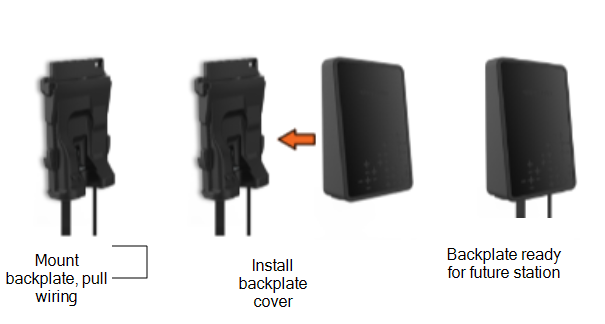
Installing Flex Plus backplates now can streamline future upgrades. By mounting a backplate and routing essential wiring through it, you can add a charging station later with minimal additional work.
-
Mount the charging station backplate.
-
Pull the AC power and data wiring through the backplate.
-
Install the backplate cover.
See the Installation Guide for more information.
-