Essential Pre-Installation Guidelines for Electricians
Before beginning work, check the site for appropriate mounting location and electrical capacity.
-
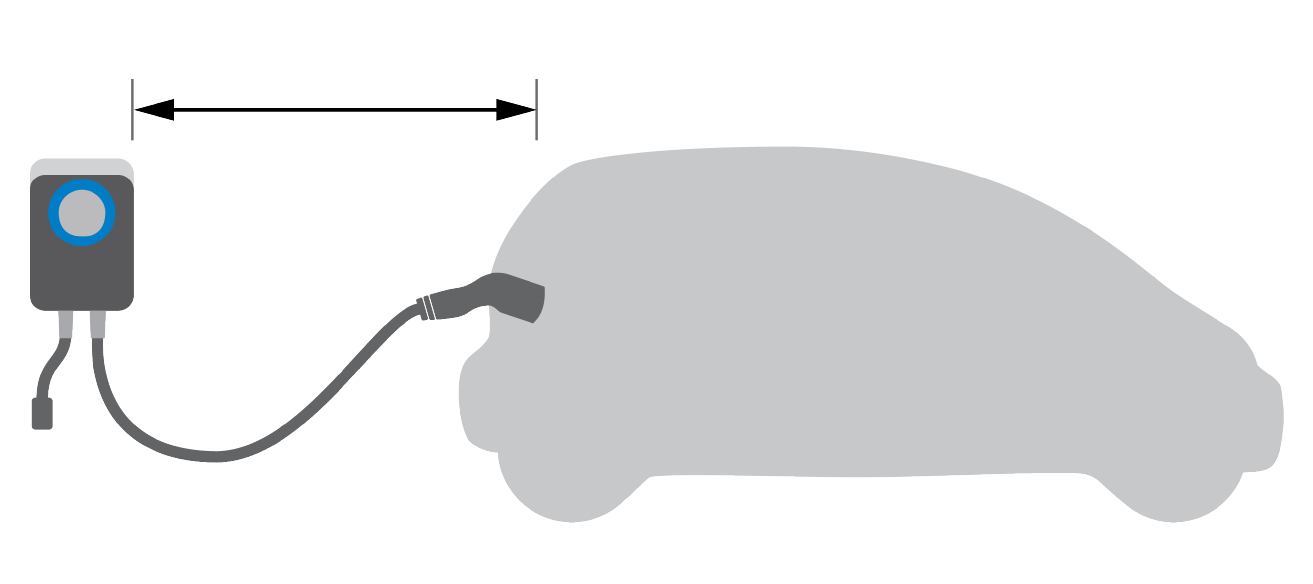
Ensure the homeowner has chosen an installation location that allows the charging cable to reach the car's charging port while still providing slack. Verify that a stud is available at the desired location for mounting the charging station. Additionally, check that there is Wi-Fi
 Wireless Fidelity signal available.
Outdoor installation is an option, but requires an outdoor-rated, weather-resistant electrical outlet or hardwired installation.
-
Determine the desired charging amperage with the homeowner. Home Flex can be installed at a variety of amperages. Choose it based on the availability of space or electrical capacity in the panel, the desired speed of charging, and whether the homeowner prefers a hardwired or plug-in installation.
Home Flex is a continuous load device. The circuit must be rated for 125% of the maximum load.Charger Ratings and Range per Hour Circuit Rating
Max Load
Estimated Range per Hour
Plug-in
Hardwire
50 A
40 A
30 miles/48 km
yes
yes
40 A
32 A
25 miles/40 km
yes
yes
30 A
24 A
18 miles/29 km
no
yes
20 A
16 A
12 miles/19 km
no
yes
In Canada, a plug-in installation is only allowed with a 50 amp circuit.Home Flex can also be wired for higher amperages. Consult all applicable codes for breaker and wire sizing requirements. The field-wiring terminal is rated to 105 ˚C and accepts a maximum of 16 mm2 (6 AWG
American Wire Gauge) wire.Charger Ratings and Range per Hour Circuit Rating
Max Load
Estimated Range per Hour
Plug-in
Hardwire
80 A
50 A
37 miles/60 km
no
yes
70 A
50 A
37 miles/60 km
no
yes
60 A
48 A
36 miles/58 km
no
yes
Only use new circuit breakers. Used breakers can damage equipment and introduce the potential for an electrical fire.
In areas with frequent thunderstorms, add surge protection at the service panel for all circuits.
Ensure all power and ground connections, especially those at the breaker and bus bar, are clean and tight. Remove all oxide from all conductors and terminals before connecting the wiring.
-
Determine the plug type purchased by the homeowner. It is either a NEMA
National Electrical Manufacturers Association 6-50 or 14-50 type plug.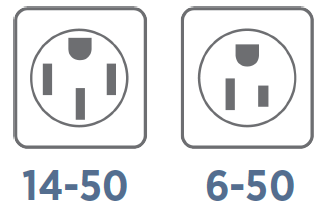
-
Determine if the desired circuit rating requires a hardwired circuit.
-
Ensure the electrical panel supports a 240 V dedicated circuit with a new, dedicated, non-GFCI
Ground-Fault Circuit Interrupter two-pole circuit breaker, in accordance with local codes and ordinances.If local codes require a GFCI
Ground-Fault Circuit Interrupter breaker for plug-in installation, ChargePoint recommends a hardwire installation. We do not recommend using a GFCI Ground-Fault Circuit Interrupter breaker as the Home Flex has Charging Circuit Interrupting Device (CCID Charge Circuit Interrupting Device) protection. A GFCI Ground-Fault Circuit Interrupter breaker in the panel causes nuisance tripping. -
For plug-in installations, the NEMA
National Electrical Manufacturers Association outlet should be located 500–660 mm (20–26 in) from the ground adjacent to the stud where the charging station will be mounted.The input power cable is 300 mm (12 in) long (as per the National Electric Code for EV
Electric Vehicle chargers). Ensure that the outlet is installed close enough to the stud for the input power cable to be plugged in.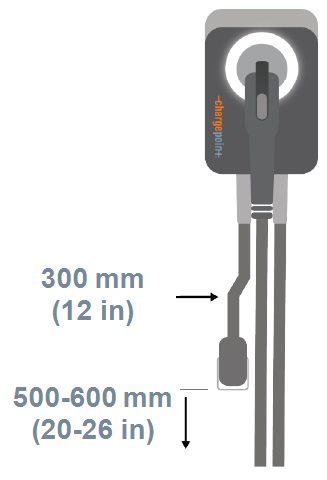
-
Follow all applicable codes and ordinances and pull a permit for completing the electrical work as required.
Refer to Installation Guide for additional information.