Introduction
This topic describes how to design a project site for the ChargePoint CP4000 charging station for electric vehicles. This includes guidelines and best practices for electrical infrastructure and capacity planning, construction and concrete work required prior to installation of charging stations, and cellular signal requirements.
For full specifications and certifications for CP4000 charging stations, refer to the CP4000 Datasheet found online at: ChargePoint Product Reference Documentation.
- If the charging station is not installed, commissioned, or serviced by a ChargePoint certified technician using a ChargePoint-approved method, it is excluded from all ChargePoint and other warranties and ChargePoint is not responsible.
- You must be a licensed electrician and complete training at https://www.chargepoint.com/partners/training-certification to become ChargePoint certified and to access ChargePoint's web-based installer tools or ChargePoint Installer app.
Initial Site Guidelines
ChargePoint recommends the CP4000 charging station solution for home and commercial charging station installations.
An onsite evaluation is needed to determine conduit and wiring requirements from the panel to the proposed parking spaces, to evaluate construction and concrete requirements for mounting the charging stations, and to measure cellular signal levels for the station and identify suitable locations for any necessary cellular signal booster equipment.
Site Requirements
The site requirements are as follows:
-
Must be at an elevation no greater than 2000 meters above mean sea level.
-
Must not expose the charging station to ambient temperatures above 50 °C, including through external influences such as direct sunlight.
-
Must have sufficient air circulation so that the station is cooled during operation.
-
Must be located where a vehicle can be parked between 0.5 m and 5.0 m from the charging station and connected without putting strain on the charging cable.
Mounting Requirements
The CP4000 can be mounted on a concrete pedestal or on a wall.
The wall mounting requirements are as follows:
-
Must be on a smooth, plumb, stable, strong wall.
-
Can be mounted on wood stud, masonry, or concrete walls.
The pedestal mount requirements are as follows:
-
Must be on concrete that is a minimum 600 mm wide x 600 mm long x 600 mm deep.
-
Must not be installed in asphalt.
Power Supply Requirements
Review the CP4000 Datasheet at ChargePoint Product Reference Documentation.
The ChargePointCP4000 charging station is designed to operate on rated voltages of 230 V (phase-neutral) or 400 V (phase-phase) at 50 Hz.
CP4000 charging station installations must comply with all regulatory requirements for low voltage installations according to IEC 60364-1 and IEC 60364-5-52.
Consult with your electricity grid operator regarding requirements for local regulations. Depending on the desired rated power, the installation of the charging station may require registration with and/or approval by your electricity grid operator.
Each charging station requires:
-
A dedicated three phase or single phase electrical circuit.
-
A new circuit breaker at the electrical panel.
-
Electrical cable and conduit installed in the appropriate location with appropriate circuit protection and metering, in accordance with all local codes and regulations.
-
An upstream MCB
 Miniature Circuit Breaker (Type Cx) for every supply line. The “x” depends on the nominal current of the supply line from the MCB Miniature Circuit Breaker to the charging station.
The CP4000 delivers up to 22.2 kW per charging port. Refer to the Datasheet for additional circuit sharing and power select options. Various options are available for power management. If a site has limited power capacity or needs to reduce costs for electrical infrastructure, consider ChargePoint power management options for power sharing at the circuit, panel, transformer, or site level. Refer to the Datasheet for complete details on available power management options.
Cellular Connectivity
The CP4000 charging station needs strong cellular connectivity to allow it to communicate with the ChargePoint network. To ensure adequate signal strength in underground garages or other enclosed parking structures, mobile network repeaters may be required.
A connection is needed for station owners and operators to access these features:
-
User authentication, access control, and billing
-
Energy usage reporting
-
Charging station utilization and charging session details for analytical reporting
-
Automatic power management
-
Real-time charging status to drivers using the ChargePoint mobile app or web portal
-
Ability for drivers to use the ChargePoint mobile app and Tap to Charge, Apple Pay, or Android Pay on their smartphone to start and stop sessions
-
Notifications to drivers when vehicle battery is full or stops charging
-
Notifications to drivers regarding waitlist position
-
Notifications to drivers prior to pricing increases for overstay of parking at EV
Electric Vehicle spots -
Station fault alarms and remote diagnostic capability
-
Over-the-air software upgrades for new station features or enhancements
If you have preexisting infrastructure or are using your own preferred electrical contractor to prepare your site, a completed Construction Signoff Form is required to certify compliance with electrical specification requirements, and to ensure everything was prepared to ChargePoint specifications.
Charging Station Placement
Layout Considerations
The layout considerations are as follows:
-
Identify station locations for EV
Electric Vehicle charging spots. -
To help minimize costs, choose station locations that are as close as possible to the available electrical infrastructure.
-
Determine raceway or conduit runs for electrical wiring from the electrical panel and consider a layout to minimize linear conduit costs to all proposed EV
Electric Vehicle parking spaces. -
If possible, avoid or minimize trenching requirements, especially more costly trenching to run conduit under asphalt surfaces.
-
Consider locations where it will be easy to add future stations.
-
Identify suitable locations with smooth, plumb surfaces for wall mount stations or suitable floor surfaces for pedestal mount stations.
-
The charging station must not block ramps or pathways, and cables must not extend across ramps or pathways when connected to a vehicle. Avoid high pedestrian traffic areas such as thoroughfares and marked escape routes.
-
The charging station must not be installed in close vicinity to running water, sprinklers, water jets, or irrigation systems.
-
Choose adjacent parking spaces in an area with adequate lighting.
-
For stall parking, ChargePoint prefers using perpendicular parking stalls to better accommodate vehicles with front and rear charge ports.
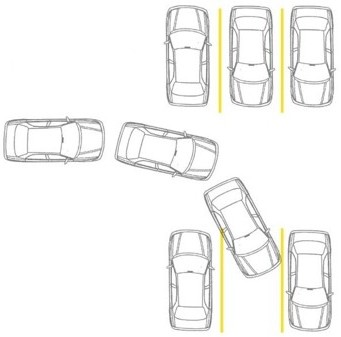 While ChargePoint tests charging stations with a majority of upcoming vehicles, ChargePoint cannot guarantee the port locations of future vehicles and cannot warrant the configurations proposed will work for all vehicles.
 -
Consider how easily drivers can find the stations they need to access.
-
Use dual-port pedestal mount stations where possible in open areas for adjacent parking or adjoining parking spaces.
-
Consider protective bollards and wheel stops where appropriate, especially for open tandem parking spaces.
Electrical Considerations
The electrical considerations are as follows:
-
Evaluate existing electrical infrastructure to determine if the existing utility service and electrical panel capacity is sufficient.
-
Ensure the electrical wiring, overcurrent circuit protection, and metering (if required) is in place by reviewing the datasheet, as well as the wiring diagram and grounding requirements in this document.
-
Use 16 mm2 or 10 mm2 wire to the station.
-
The cable entering the station must be less than 25 mm in diameter. For higher demand, you must feed the station with two circuits, each with a maximum diameter of 25 mm.
-
The station must be grounded adequately according to local code requirements.
-
Size all conduit and electrical wiring in accordance with all local code requirements. ChargePoint recommends using a certified electrician to evaluate available capacity and identify any upgrades that may be required.
-
If a dedicated EV
Electric Vehicle electrical panel is required, choose a panel location in close proximity to the existing electrical supply.
Additional Considerations
The additional considerations are as follows:
-
Identify costs for any necessary upgrades and/or a new dedicated electrical panel.
-
Determine appropriate mounting type: wall mount vs. pedestal mount.
-
Establish the quantity of each type of charging station in the initial order.
-
Measure cellular signal levels using professional cellular test equipment to ensure adequate cellular coverage at the charging station location.
To ensure adequate cellular signal strength in underground or enclosed parking structures, cellular repeaters may be required. Use an indoor antenna located near EV Electric Vehicle parking spaces andan outdoor antenna typically located at the garage entrance ceiling or on the rooftop where cellular signals are best. See additional details in Cellular Connectivity.
-
Determine cost budget options for electrical infrastructure to satisfy current needs and future needs.
-
Prioritize charging stations locations based upon immediate and future needs, construction timelines, and costs.
Plan for the Future
Consider both current and future EV Electric Vehicle charging needs as EV Electric Vehicle adoption grows.
-
Add extra capacity if electrical panels are being upgraded now.
-
Use sub-panels as a way to shorten electrical path.
-
Consider running raceway or conduit to all planned EV
Electric Vehicle parking spots, but pulling electrical wiring from the panel to meet current needs. -
Oversize the conduit between the main electrical panel and future stations.
-
Install pull or junction boxes at the end of an existing row of charging stations to ease cable pulls for future stations.
-
Consider installing a dedicated electrical panel for EV
Electric Vehicle charging, then leverage ChargePoint power management to efficiently use available power at a site to support more EV Electric Vehicle charging ports than would otherwise be possible without power management.