Site Design Guidelines
Initial Site Guidelines
An onsite evaluation is needed to determine conduit and wiring requirements from the panel to the proposed bus charging locations, as well as to measure cellular signal levels and identify suitable locations for any necessary cellular signal booster equipment.
If you have pre-existing infrastructure or are using your own preferred electrical contractor to prepare your site, a Pantograph Down 2000 Construction Signoff Form completed by a ChargePoint Operations and Maintenance (O&M) partner is required to certify compliance with electrical code and to ensure everything was prepared to ChargePoint specifications. Refer to the Pantograph Down 2000 Construction Signoff Form available on the ChargePoint Product Reference Documentation site for details.
- If the charging station is not installed, commissioned, or serviced by a ChargePoint certified technician using a ChargePoint-approved method, it is excluded from all ChargePoint and other warranties and ChargePoint is not responsible.
- You must be a licensed electrician and complete training at https://www.chargepoint.com/partners/training-certification to become ChargePoint certified and to access ChargePoint's web-based installer tools or ChargePoint Installer app.
Plan for Future Charging Capacity
Designing electrical infrastructure to support current and future needs for EV Electric Vehicle charging helps avoid costly upgrades later as demand for EV Electric Vehicle charging grows.
Consider these methods to prepare a site for future charging stations in a later phase of work:
-
Add extra capacity if electrical panels are being upgraded now.
-
Use sub-panels as a way to shorten electrical paths.
-
Maximize the conduit and conductor sizes (to product specifications) between the main electrical panel and future stations, to prevent needing to re-pull wire later.
-
Below-ground wiring can be pre-staged if the correct site construction is performed in advance. Allowed terminations include a distribution unit, junction box, or plugged conduit. This eases cable pulls for future stations.
-
Consider locations and spaces where it will be easy to add future stations.
System Placement
The placement of the Pantograph Down 2000 solution must meet the following requirements:
- Do not install Pantograph Down 2000 in a Class 1 hazardous location, as classified by NEC National Electric Code or local codes.
- Site conditions must be compatible with the following specifications listed in the Pantograph Down 2000 datasheet:
- Operational altitude
- Operating temperature
- Operating humidity
- Enclosure rating
- The maximum wind speed under which the Schunk 201.102 pantograph can operate is 74 mph (11.6 Bft).
- Pantograph Down 2000 components must be installed on a surface rated for the weight of the component:
- A level concrete base for Power Blocks
- An overhead structure or wall, supported by a concrete base for Power Link 2000s and PD Controllers
- An overhead structure supported by a concrete base for pantographs
Determine component installation locations where concrete exists or can be installed (no asphalt surfaces).
- The ground beneath the pantograph must not exceed a 10 degree grade.
- The utility service and electrical panel capacity must be sufficient for the site. Evaluate the existing service and infrastructure, and identify costs for any necessary upgrades and/or a new dedicated electrical panel. ChargePoint recommends using a certified electrician to evaluate available capacity and identify any upgrades that may be required.
- If a dedicated EV Electric Vehicle electrical panel is required, choose a panel located close to the existing electrical supply.
- Measure cellular signal levels at the installation site to ensure adequate cellular coverage at the Power Link 2000. To ensure adequate signal strength in underground or enclosed parking structures, cellular repeaters may be required. For more information, see Connectivity.
- Component placement must comply with regional regulations and ordinances. Do not block ramps or pathways.
- For any pantograph installed outdoors, a roof shield (overhead covering) is required to protect the pantograph from UV exposure. In regions that experience snow or ice conditions, the roof shield also prevents build up of snow or ice on the pantograph. In regions that experience freezing rain or horizontal snow fall, equipping the pantograph with side shields is recommended.
- Maximum distances between system components is defined by the maximum specified wire run lengths. See Wire Run Lengths.
The following practices are recommended:
- To minimize costs, choose station locations that are as close as possible to the available electrical infrastructure. Selecting nearby locations helps minimize long wire runs as well as any conduit or trenching work if the site uses underground service wiring.
- Determine the best conduit layout to minimize linear conduit costs to multiple parking spaces. If possible, avoid or minimize trenching requirements, especially more costly trenching to run conduit under asphalt surfaces.
- Avoid installing Pantograph Down 2000 components near trees where falling sap, pollen, or leaves would increase station maintenance workload.
There are additional considerations if placing Power Link 2000 inside an enclosed structure. See Appendix: Enclosed Power Link 2000 Considerations.
Pantograph Placement Relative to Bus
Pantograph Down 2000 requires correct alignment between charging system components and the bus per the SAE International J3105-1 standard. This standard specifies the dimensions of the bus contact rails and the position of the contact rails on top of the bus. See www.sae.org for more information.
Pantograph Position and Orientation
The pantograph must be positioned such that its conductor rails lower directly onto the bus contact rails, perpendicular to the bus rails, and centered over the bus rails. The pantograph must install in the correct orientation, such that:
-
The pantograph DC+ conductor rail aligns to the bus DC+ contact rail.
-
The pantograph DC- conductor rail aligns to the bus DC- contact rail.
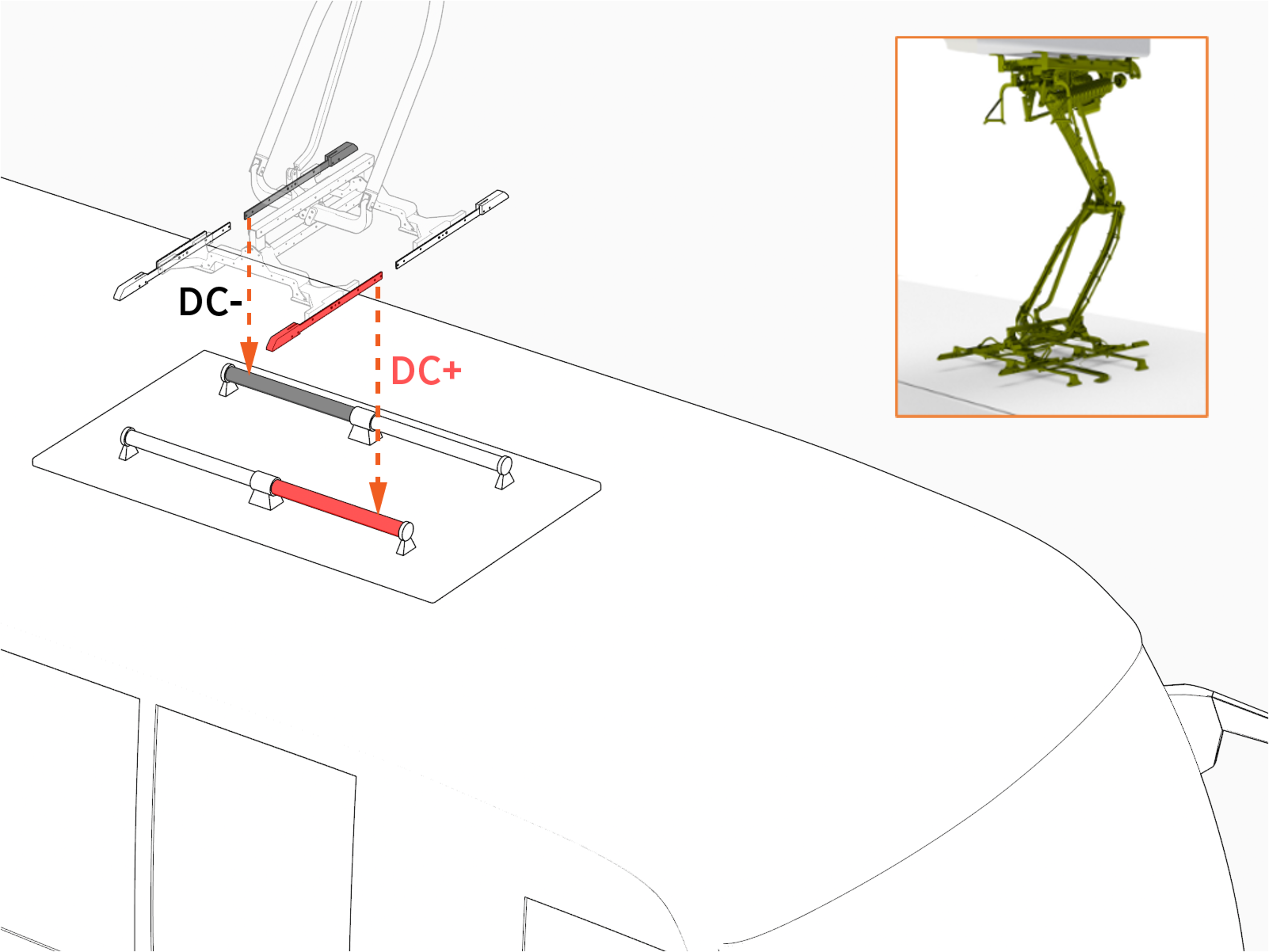
For pantograph height relative to the charging rails, refer to manufacturer product datasheets at
Maximum Slope in Transverse Direction
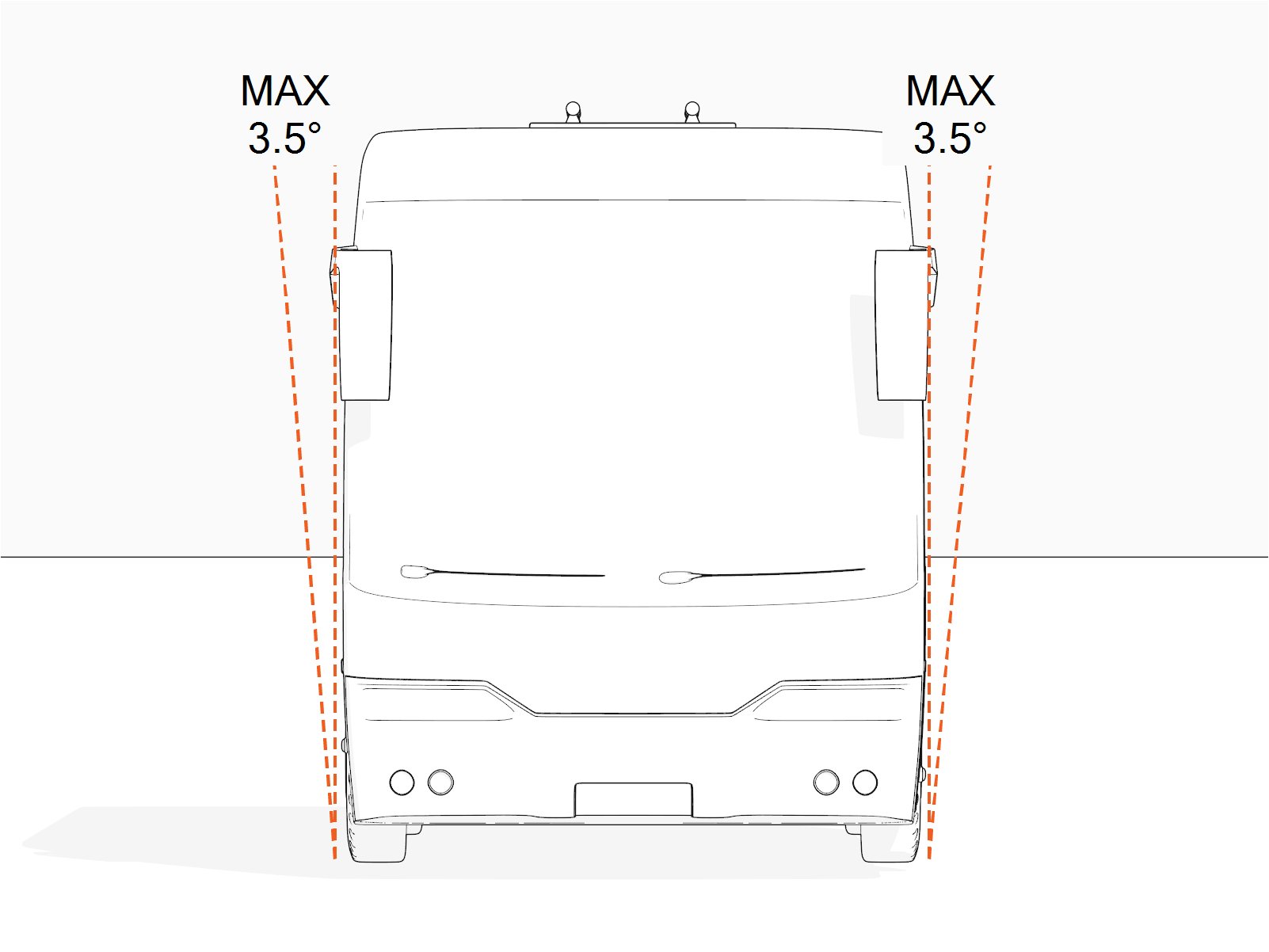
The transverse direction is the direction in the plane of the road and perpendicular to the bus driving direction. The maximum angle the bus may tilt in the transverse direction is 3.5 degrees, whether due to a tilt in part of the parking surface beneath the bus or due to the bus kneeling. A transverse tilt of the bus will shift the top of the bus relative to the center axis of the bus and should be taken into account when calculating placement of the pantograph. In general, the plane of the pantograph rails should be as parallel as possible to the bus parking surface.
Maximum Slope in Longitudinal Direction
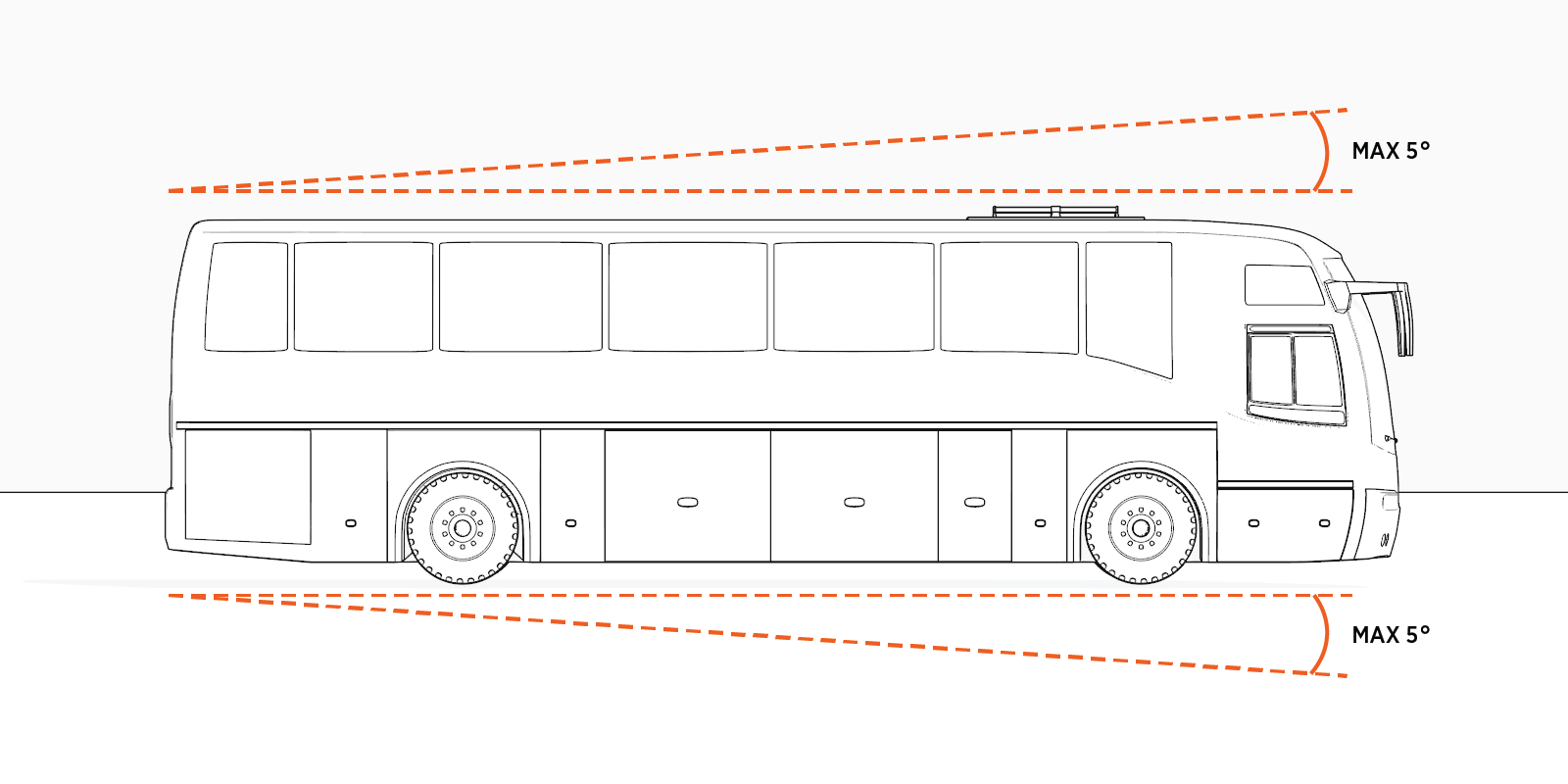
The maximum ramp angle of the bus in the longitudinal direction (driving direction of bus) is 5 degrees. A longitudinal tilt of the bus will shift the top of the bus relative to the center axis of the bus and should be taken into account when calculating placement of the pantograph. In general, the plane of the pantograph rails should be as parallel as possible to the bus parking surface.
Maximum Offset Angle Relative to Curb
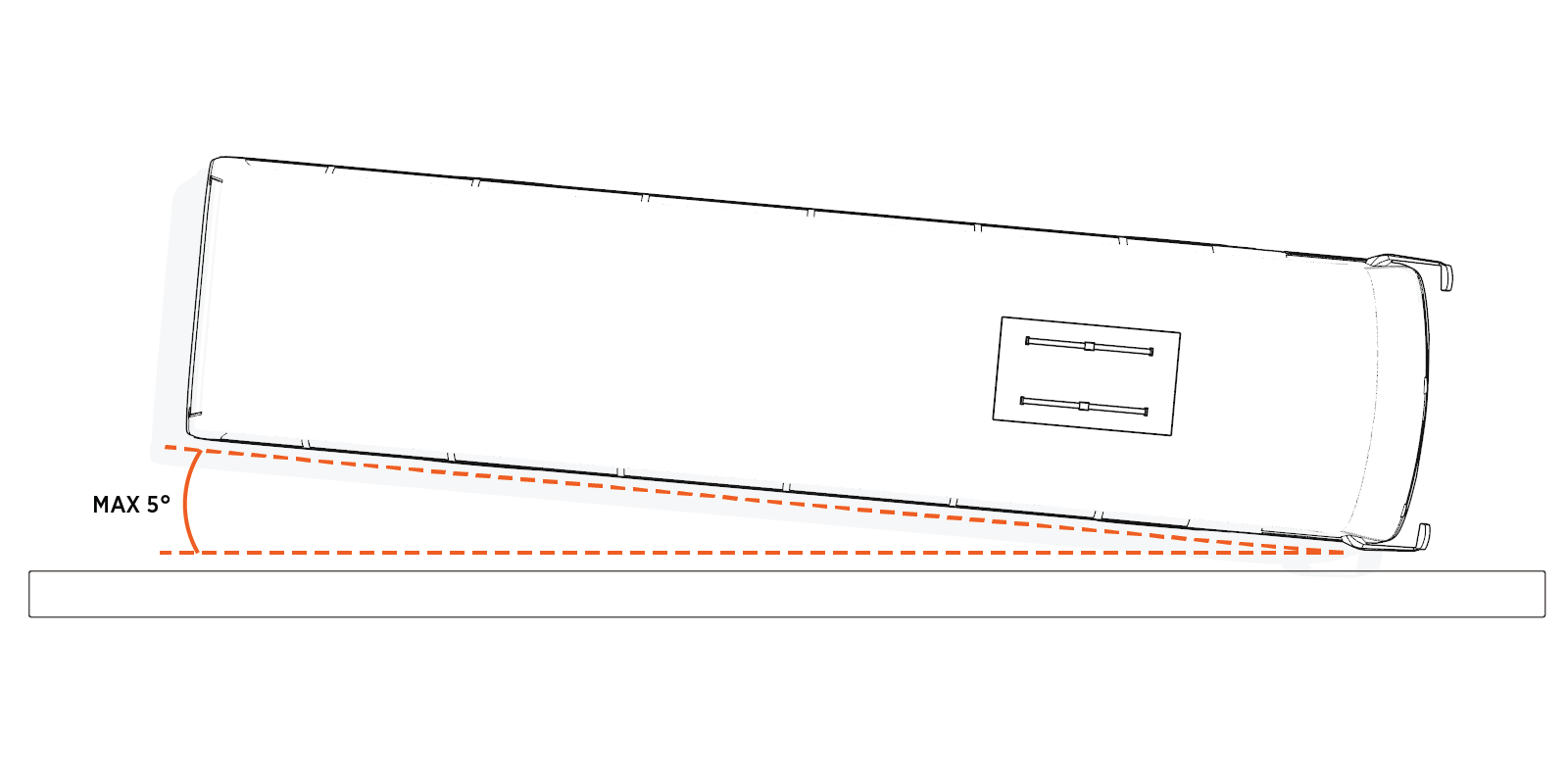
Pantograph Down 2000 accommodates a maximum angle for vehicle offset from the curb of 5 degrees.
Parking Guides
Consider adding guides to the site to indicate to the bus driver when they are parked in the correct position underneath the pantograph for charging. Options include painting the road surface, installing a visual marker, and modifying the road surface for tactile feedback.