Civil and Mechanical Design
Weights
| Component |
Variant or Note |
Weight |
|---|---|---|
|
Power Module |
— |
45 kg (99.2 lb) |
|
Power Block |
Equipped with (x5) Power Modules |
680 kg (1500 lb) |
|
Power Link 2000 |
Overhead-mount enclosure |
130 kg (287 lb) |
|
PD Controller |
— |
32.2 kg (71 lb) |
|
Pantographs |
Schunk SLS 201.102 |
Refer to manufacturer datasheets at |
|
Auxiliary components assembly (Wi-Fi
|
For use with Schunk SLS 201 pantographs |
52.2 kg (115 lb) |
Dimensions
Power Block

Power Link 2000
Overhead-Mount Enclosure
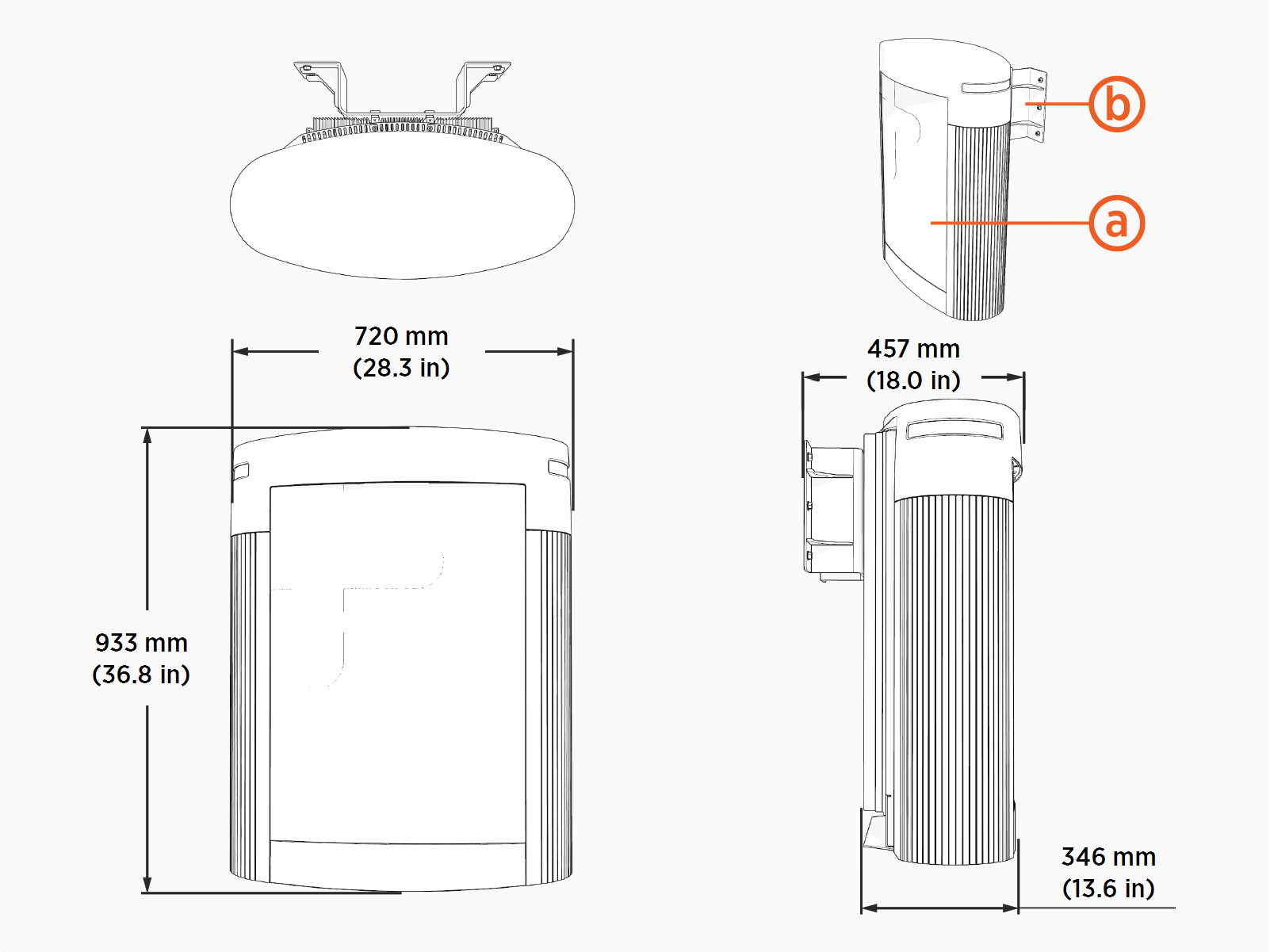
-
Enclosure
-
Mounting bracket
PD Controller

-
Enclosure
-
Lifting eye bolts (optional removal after enclosure mount)
-
Lifting brackets (mandatory removal after enclosure mount)
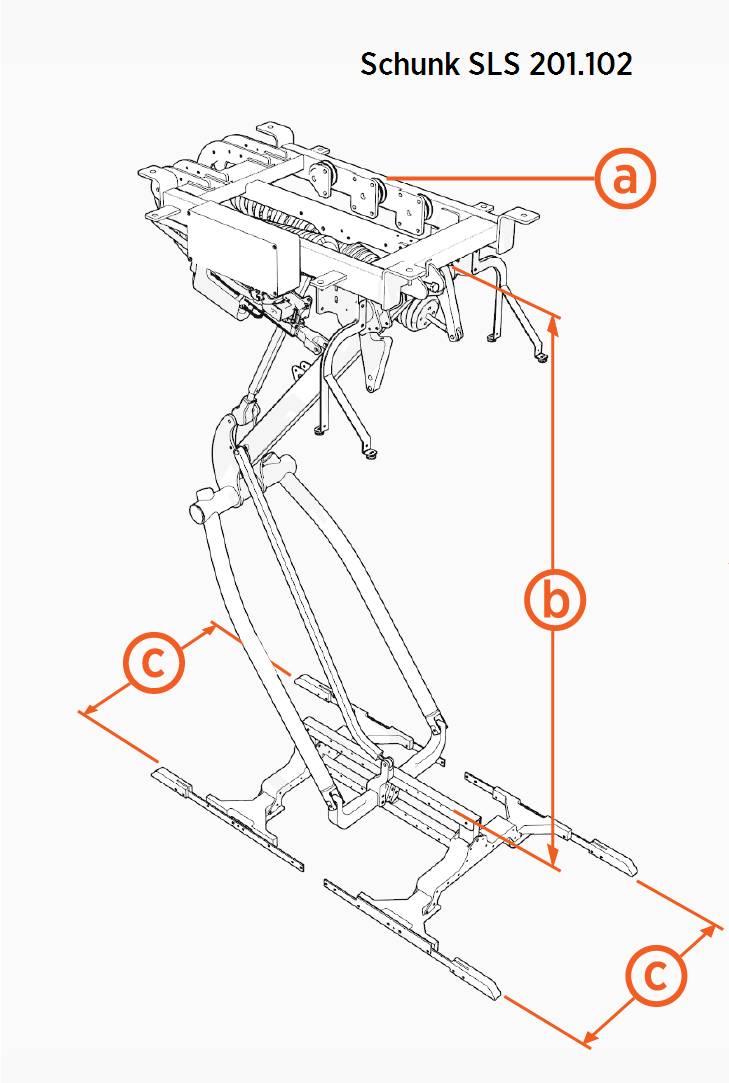
Pantographs
For pantograph dimensions, refer to the manufacturer's product datasheets at
|
|
|
Auxiliary Components
The Wi-Fi Wireless Fidelity antenna, RFID Radio Frequency IDentification antenna, and status LED are collectively referred to as auxiliary components.
-
Wi-Fi
Wireless Fidelity Antenna
-
RFID
Radio Frequency IDentification Antenna
-
Status LED

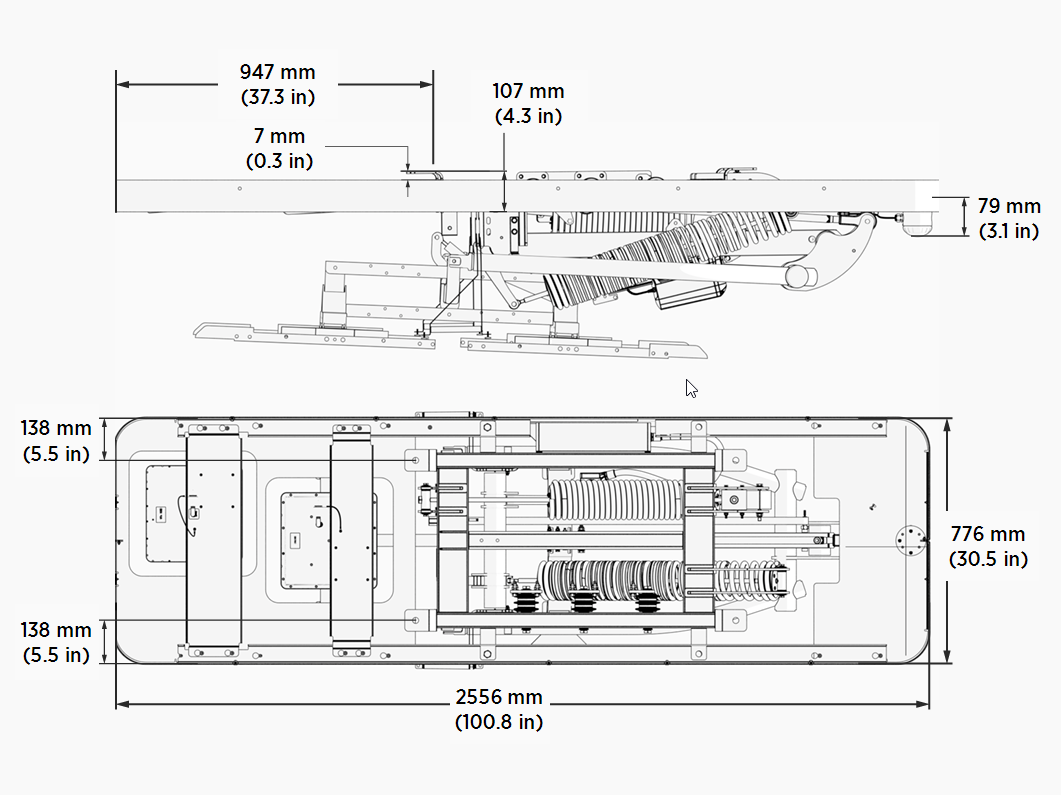
For use with the Schunk SLS 201.102 pantograph, these components attach to a mounting frame, which in turn attaches to the pantograph. For dimensions of the entire assembly, see Auxiliary Component Mount.

-
Wi-Fi
Wireless Fidelity antenna -
Status LED
-
Mounting frame
Dimensions of the Wi-Fi Wireless Fidelity antenna and RFID Radio Frequency IDentification antenna alone can be found on their manufacturer product datasheets:
| Antenna | Manufacturer | Model Name | Part Number | Website |
|---|---|---|---|---|
| Wi-Fi Wireless Fidelity
|
HUBER+SUHNER | SENCITY® Spot-L Wi-Fi Wireless Fidelity Antenna |
1354.17.0001 |
|
| RFID Radio Frequency IDentification
|
RFMAX Antennas | R9029WHPRTF Circularly Polarized RFID Radio Frequency IDentification Antenna |
R9029-WHP-RTF | rfmax.com |
Mount Specifications
| Component | Mount Surface |
|---|---|
| Power Block |
Concrete pad (new or existing) |
| Power Link 2000 |
Overhead structure, wall, or within a mast structure |
| PD Controller |
Overhead structure, wall, or within a mast structure |
| Pantograph | Overhead structure, including suspension from a mast structure |
Additional mount specifications for each component are provided in the following sections.
Power Block Mount
Concrete Pad Specifications
The Power Block must be installed on a concrete pad. The concrete pad may be either newly poured or it may be an existing concrete surface.
The concrete pad must either be designed to be site-specific or must meet the one of the specifications provided below. In some extreme conditions, a larger pad may be required. For sites with less stringent seismic, soil, or wind conditions, a smaller pad might be possible.
Conservative concrete stability specifications for the Power Block are listed below for the following design scenarios:
-
170 mph wind, high seismic, Class 3 Soil
-
170 mph wind, high seismic, Class 4 Soil
-
170 mph wind, high seismic, Class 5 Soil
-
140 mph wind, lower seismic, Class 3 Soil
-
140 mph wind, lower seismic, Class 4 Soil
-
140 mph wind, lower seismic, Class 5 Soil
All scenarios assume:
-
Minimum concrete rating of 2500 PSI.
-
All-threaded M16 anchor bolts are embedded 229 mm (9 in) into concrete pad, are made of ASTM F1554 Grade 55 carbon steel, and are hot dip galvanized.
-
The anchor bolt pattern is centered within the designed stability area.
|
Design Scenario # |
B1, |
B2, |
T, |
#N1 @ S1” O.C. |
#N2 @ S2” O.C. |
|---|---|---|---|---|---|
|
1 |
1753 mm |
1753 mm |
457 mm |
#4 @ 305 mm (12 in) O.C. |
#4 @ 305 mm (12 in) O.C. |
|
2 |
1753 mm |
1753 mm |
686 mm |
#4 @ 152 mm (6 in) O.C. |
#4 @ 152 mm (6 in) O.C. |
|
3 |
1524 mm |
1524 mm |
457 mm |
#4 @ 305 mm (12 in) O.C. |
#4 @ 305 mm (12 in) O.C |
|
4 |
1524 mm |
1524 mm |
457 mm |
#4 @ 305 mm (12 in) O.C. |
#4 @ 305 mm (12 in) O.C. |
|
5 |
1524 mm |
1524 mm |
457 mm |
#4 @ 305 mm (12 in) O.C. |
#4 @ 305 mm (12 in) O.C. |
|
6 |
1524 mm |
1524 mm |
457 mm |
#4 @ 305 mm (12 in) O.C. |
#4 @ 305 mm (12 in) O.C. |
| Specification | Details |
|---|---|
|
Weight |
680 kg (1500 lb) |
|
Height x width |
2191 mm (86.3 in) x 1000 mm (39.4 in) |
|
Frontal area |
Height * Width |
|
CG height |
1000 mm (39.4 in) |
|
Anchor bolts size and quantity |
M16 (x4) |
|
Anchor bolts embedment |
229 mm (9 in) |
| Anchor bolts placement | See Anchor Bolt Placement |
Anchor Bolt Placement
The Power Block mounts over four anchor bolts embedded in a concrete pad with the anchor bolt pattern shown here.

Standard Mount
The most common mounting method for the Power Block is a new pad installation using a Concrete Mounting Template (CMT) and conduit stub-up wire entry:

-
The Power Block pedestal (a) mounts onto four M16 anchor bolts (b) exposed 76 mm (3 in) above the concrete pad.
-
The CMT (c) is embedded into a newly poured concrete pad (d) to align anchor bolts and underground stub-up wiring conduits. (Conduits are not shown in illustration.)
The CMT is shipped separately and must be assembled onsite before pouring the concrete pad. The CMT must be embedded with its top panel positioned 51 mm (2 in) below the concrete surface. Refer to the Concrete Mounting Template Guide for more information. -
In regions that use conduits, the conduits must not have bell ends. Conduits with bell ends may interfere with tolerances inside the Power Block.
-
Conduits must stub up 559–914 mm (22–36 in) above the concrete pad surface.
Power Block CMT
The Power Block CMT positions the anchor bolts and wire entry as shown below.

-
M16 anchor bolt (x2) locations for mounting SCE
Surface Conduit Entry gland plate (applicable only for surface conduit entry). -
M16 anchor bolt (x4) locations for mounting Power Block (see Anchor Bolt Placement).
-
HV DC
High Voltage Direct Current output B wires exit. -
HV DC
High Voltage Direct Current output A wires exit.The DC output of Power Block is the DC input for Power Link 2000. -
AC input wires entry.
-
LV DC
Low Voltage Direct Current output wires, shunt trip wires, and Ethernet cable exit.-
One for shunt trip (if used).
-
Three for LV DC
Low Voltage Direct Current and Ethernet.
-
Surface Mount
The Power Block may be installed on an existing concrete surface in accordance with the following guidelines:
-
The concrete surface must be inspected and approved by a structural engineer, as described in Concrete Pad Specifications.
-
The anchor bolts must be installed in the concrete surface as follows:
-
Anchor holes are drilled into the concrete using the anchor bolt pattern given in Anchor Bolt Placement. The holes are drilled to a depth so that 76 mm (3 in) of each anchor bolt is exposed above the concrete pad.
-
Anchor bolts are epoxied into the holes. Use an epoxy with a minimum bonding strength of 11.7 MPa, compressive strength of 82.7 MPa minimum, and tensile strength of 49.3 MPa minimum. Examples include Hilti HIT-RE 500 V3 (normal cure) or Hilti HIT-HY 200-A (fast cure).
Epoxy is required only if embedding anchor bolts into an existing concrete pad. It is not applicable for a new concrete pour with CMT. Different epoxy types have different cure times at various temperatures. Check local temperatures for the site in advance to help choose an appropriate epoxy.
-
-
The anchor bolts must be hot dip galvanized.
Power Block Surface Conduit Entry Kit
Power Block supports wiring that is run above ground in protected wireways, for locations where no underground wiring access exists (parking garages, etc.) or where underground junction boxes are not permitted. The Power Block Surface Conduit Entry (SCE Surface Conduit Entry) Kit provides a sturdy pedestal cover panel onto which surface conduits or armored cables may be fastened to the rear side of the Power Block.

Use the Power Block SCE Surface Conduit Entry Kit for the following benefits:
-
Supports the weight of conduits and components without compromising cover panel integrity
-
Ensures all terminations meet ingress requirements where they meet the component
-
Ensures no obstructions to ventilation required for operation
Surface Conduit Entry Kit, which includes the hardware needed to install on an existing concrete surface. See also the Power Block Surface Conduit Entry Kit Guide.
Power Link 2000 Mount
Overhead-mount enclosure
The Power Link 2000 mounts onto a wall or an overhead structure (such as a gantry) using a bracket that attaches to the back of the Power Link 2000. The bracket has six mounting holes sized for M8 bolts.


Ensure the following mounting requirements are met:
-
The Power Link 2000 must be mounted upright. Do not mount it in any other orientation.
-
The mounting surface must be smooth and plumb.
-
The mounting surface or structure must be designed or verified for the weight of the Power Link 2000 by a structural engineer per local codes. See Weights.
PD Controller Mount
The PD Controller enclosure mounts using four mounting tabs on the back edge of the enclosure. The tabs are sized to accept M8 bolts.
|
|
|


Ensure the following mounting requirements are met:
-
The PD Controller must be mounted upright. Do not mount it in any other orientation.
-
The mounting surface must be smooth and plumb.
-
The mounting surface or structure must be designed or verified for the weight of the PD Controller by a structural engineer per local codes. See Weights.
Pantograph Mount
The pantograph mounts to an overhead surface or structure:
-
The mounting surface must be smooth and parallel to the ground beneath it, within tolerances specified by Component Placement Relative to Bus.
-
The mounting surface or structure must be designed or verified for the weight of the pantograph by a structural engineer per local codes. See Weights.
Schunk SLS 201.102 mount
The Schunk SLS 201.102 pantograph mounts using four mounting supports located on its base frame, with mounting holes sized for M16 hardware. Refer to Schunk product documentation for full details and dimensions.

Auxiliary Component Mount
Schunk SLS 201.102
The Wi-Fi Wireless Fidelity antenna, RFID Radio Frequency IDentification antenna, and status LED mount to the Schunk SLS 201.102 pantograph through the use of a mounting frame. The mounting frame positions the antennas relative to the pantograph connector (and top of the bus) as required by the SAE International J3105 standard.
Drainage
Ensure any site slopes, walls, or fencing do not trap water around the installation site.
Flood Plane
Power Block is designed for a 457 mm (18 in) flood plane. If the site has a flood plane greater than 457 mm (18 in) for a 100-year flood event, consider installing the Power Block on a raised concrete pad.
Clearances
Power Block
| Two Power Blocks laid side-to-side | Two Power Blocks laid back-to-back |
|
|
|

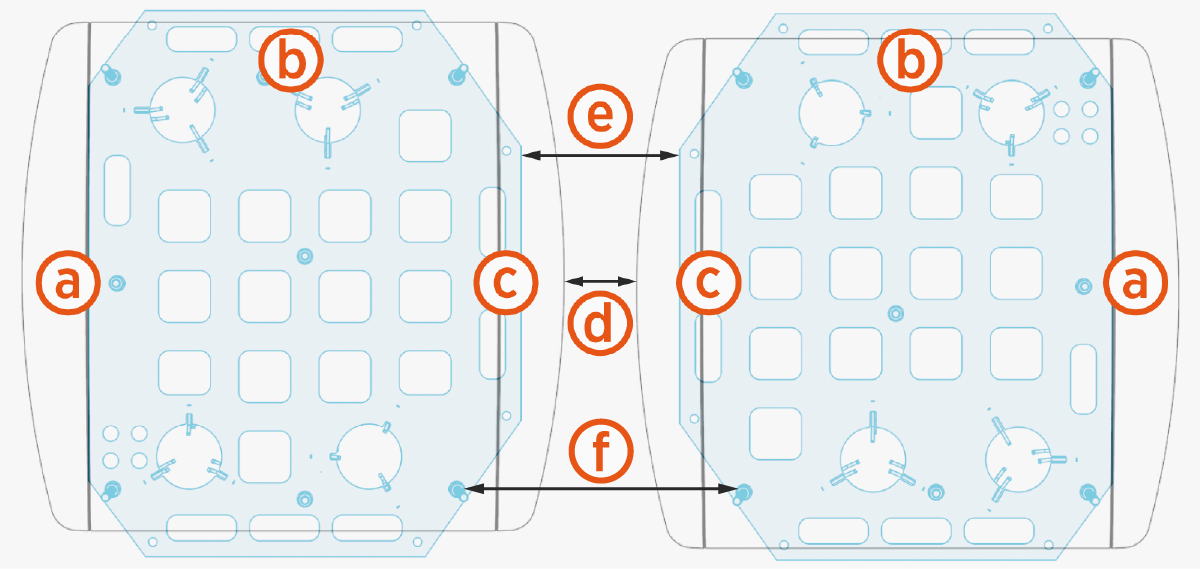
The following table provides the clearances required for service and ventilation around the Power Block (PB):
|
Side |
Power Blocks Layout |
Clearance |
||
|---|---|---|---|---|
|
(a) Front |
— |
— |
Minimum 1000 mm (39.4 in) |
|
|
(b) Sides
|
PBs laid side-to-side |
Minimum
|
(d) PB to PB |
51 mm (2 in) |
|
(f) Center of anchor bolt to center of anchor bolt |
245 mm (9.6 in) |
|||
|
Recommended |
(d) PB to PB |
152 - 203 mm (6 - 8 in) |
||
|
(e) CMT to CMT |
116 - 167 mm (3.4 - 5.4 in) |
|||
|
(f) Center of anchor bolt to center of anchor bolt |
376 - 427 mm (14.8 - 16.8 in) |
|||
|
(c) Rear |
PBs laid back-to-back |
|
(d) PB to PB |
457 - 609 mm (18 - 24 in) |
|
(e) CMT to CMT |
609 - 761 mm (24 - 30 in) |
|||
|
(f) Center of anchor bolt to center of anchor bolt |
857 – 1009 mm (33.7 - 39.7 in) |
|||
|
If placing two Power Blocks back-to-back using surface conduit entry, there must be at least 609 mm (24 in) of shared rear clearance.
|
||||
Additionally, follow the clearance guidelines below:
-
Front and rear clearances must be at grade level +/- 13 mm (0.5 in).
-
The interior of the Power Block is accessed from both the front and rear cover panels, which lift off. No separate door swing clearance is required.
-
Fencing, bollards, or wheel stops must not encroach upon the clearances listed above, if present. These barriers are not explicitly required by ChargePoint.
-
Power Blocks can be laid side-to-side with minimal spacing for service and ventilation. If laid side-to-side, wiring can enter using either stub-up entry (recommended) or using surface entry at the rear side. When laid side-to-side, wiring for the row cannot pass through one Power Block into another.
-
Side clearances can be shared between Power Blocks as long as:
-
At least 51 mm (2 in) of clearance is maintained between each Power Block.
-
Required service clearance is maintained at the front and rear sides.
-
At least 457 mm (18 in) of clearance is available at each end of a row of Power Blocks.
-
Power Link 2000
The overhead-mount Power Link 2000 requires the minimum site and service clearances listed below.
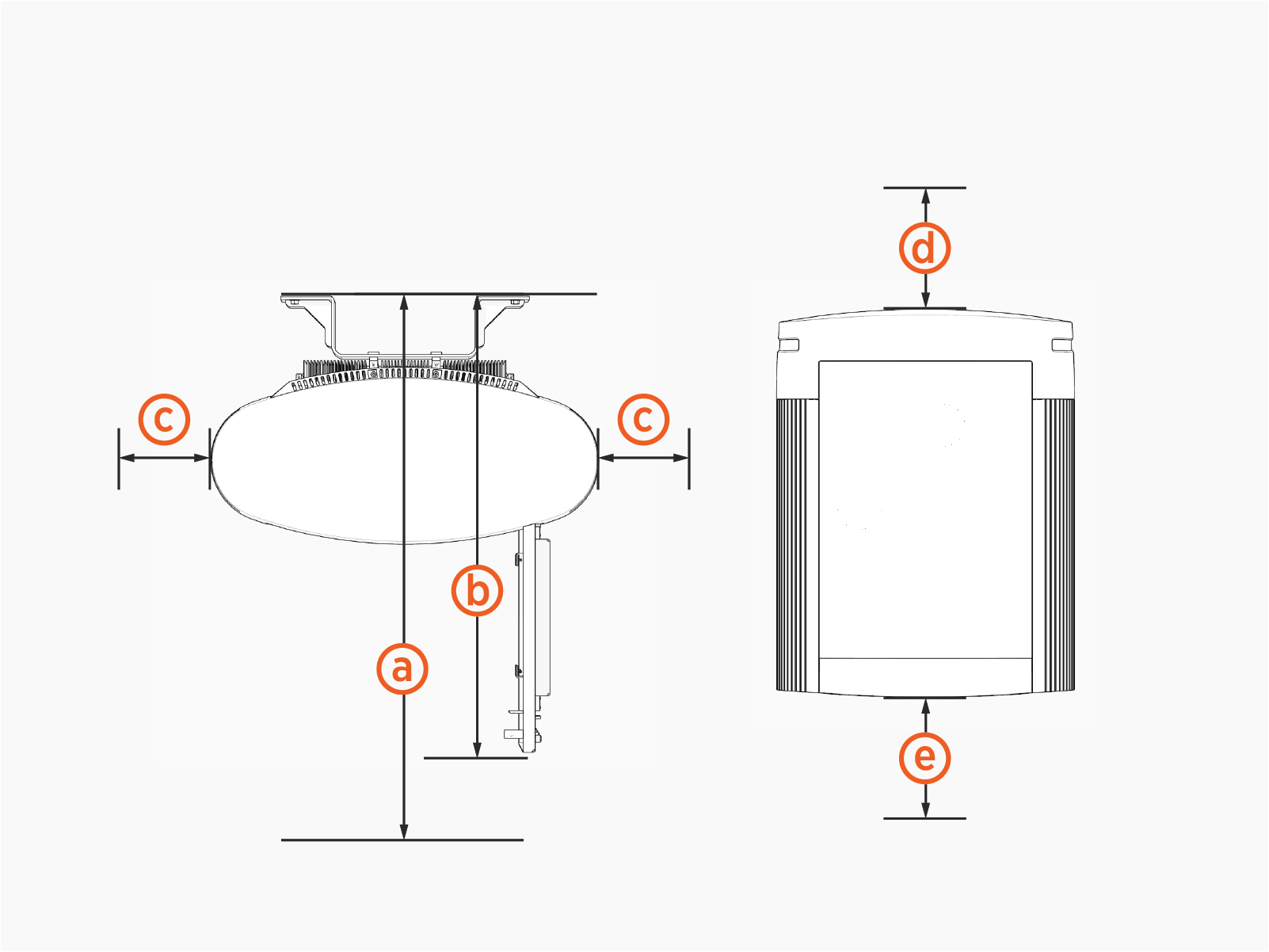
|
Location |
Clearance |
|---|---|
|
(a) Front - Minimum Open Space |
1062 mm (41.8 in) |
|
(b) Front - Door Swing + Unit Depth |
849 mm (33.5 in) |
|
(c) Sides |
305 mm (12 in) |
|
(d) Top |
305 mm (12 in) |
|
(e) Bottom |
610 mm (24 in) |
PD Controller
The PD Controller requires the minimum site and service clearances listed below.

|
Location |
Clearance |
|---|---|
|
(a) Front |
737 mm (29 in) |
|
(b) Sides |
102 mm (4 in) |
|
(c) Top |
102 mm (4 in) |
|
(d) Bottom |
250 mm (9.8 in) |
Pantograph
To accommodate installation and serviceability of pantograph wiring connections, the Schunk SLS 201.102 pantograph requires a top clearance of 120 mm (4.7 in) from the mounting tabs with the below exception.

Within the top clearance zone, any mounting solution (such as mounting rods) must exist within the area specified below.

The Schunk SLS 201.102 pantograph requires a keep out zone beneath it. The site plan should keep the zone clear of all objects except for the displayed ChargePoint-provided components.

|
Dimension |
Keep Out Zone Description |
Value |
|---|---|---|
|
(a) Height |
The height of keep out zone starts from the bottom of auxiliary component mounting frame and extends towards the ground. |
2350 mm (92.5 in) |
|
(b) Length |
The length of keep out zone spans the total length of the auxiliary component mounting frame. |
2556 mm (100.8 in) |
|
(c) Width |
The width of the keep out zone extends 100 mm (4 in) (d) beyond the sides of auxiliary component mounting frame. |
976 mm (38.3 in) |
Bollards
Bollards are not explicitly required by ChargePoint. If applicable, ChargePoint recommends these best practices and considerations when designing bollards for the site:
-
Permanent bollards must not encroach upon the clearance areas described in Clearances.
-
Removable bollards are allowed if service personnel have the ability to move them as needed.
Ventilation
Power Block
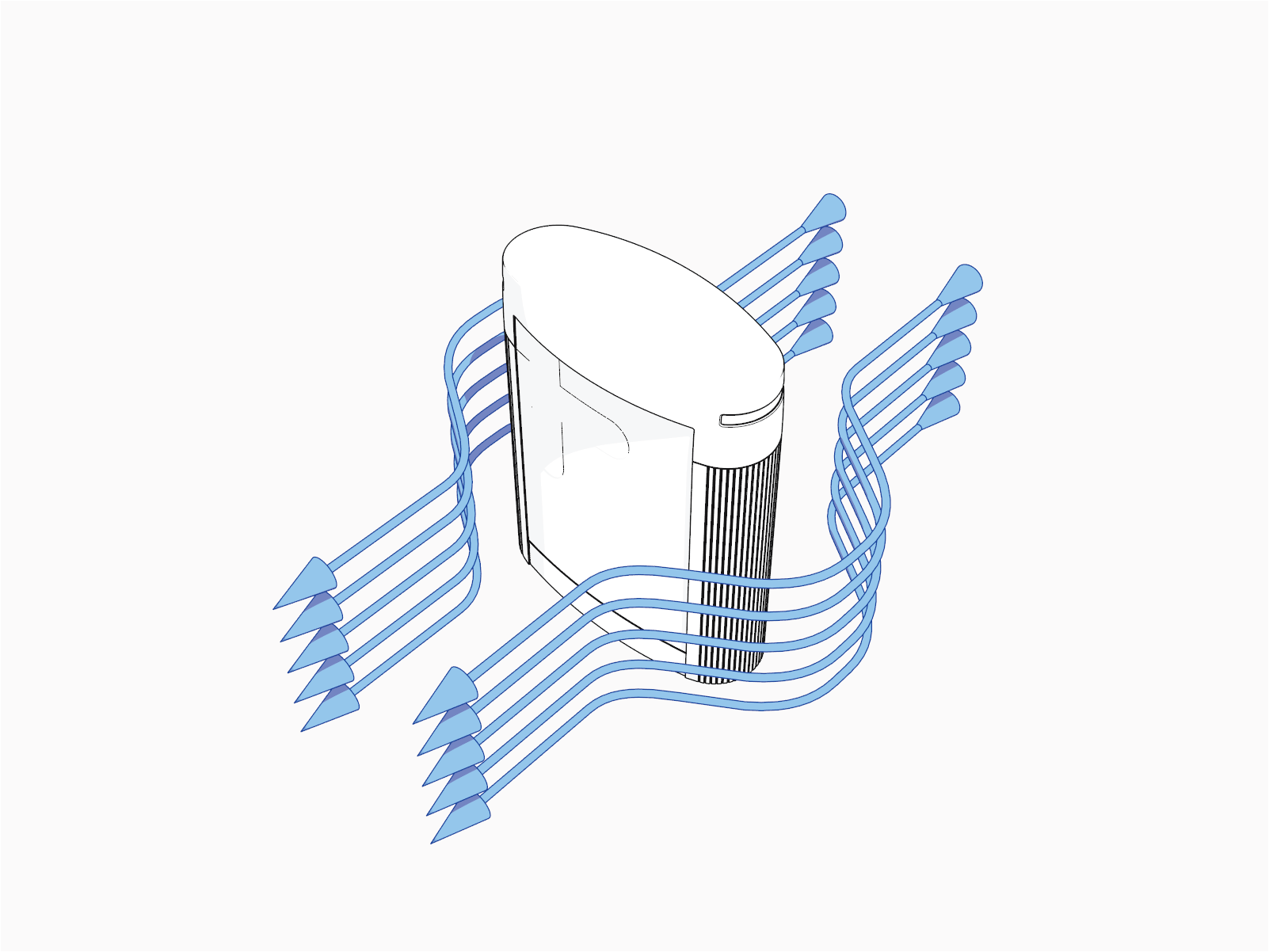
Intake vents are positioned at the front of the Power Block (blue arrows) and exhaust vents are at the rear (orange arrows). When positioning multiple Power Blocks, orient intake and exhaust to avoid recirculation.

Power Link 2000
Ensure that any installation, especially an indoor installation, has adequate airflow to dissipate heat from the station. The station location must allow fresh ambient airflow and must be free of any objects that might restrict airflow to the station. A station experiencing temperatures in excess of the maximum allowed operating temperature may deliver reduced maximum performance.
Accessibility
Comply with regional accessibility laws, regulations, and ordinances. Pantograph Down 2000 components, such as the Power Block and the Power Link 2000, must not block ramps or pathways.
Signage
Refer to local and regional code to design the following elements for the site:
-
Any required re-striping of parking spaces
-
EV
Electric Vehicle or Accessible EV Electric Vehicle signs -
EV
Electric Vehicle or Accessible EV Electric Vehicle paint markings on and around the parking spaces
ChargePoint recommends posting signage indicating the maximum drive-through height for vehicles passing beneath the chargers.