Electrical Design
Conduit and wire size are determined based on current. Service wiring in conduit or armored cable must be run as required to comply with local electrical codes. Consult national and local codes or a project engineer to determine the grade, quality, and size of the conduit or cable.
The Power Link 2000 in the Pantograph Down 2000 system can be configured to 200, 250, 350, 400, and 500 A. The corresponding rating label is applied on-site.
Power Block Electrical Supply Requirements
Charging stations are considered continuous load devices (EVs draw maximum load for long durations). Therefore, electrical branch circuits to EV Electric Vehicle chargers must be sized at 125% of the load on each leg of a 3‑phase panel for North American installations, in accordance with National Electric Code requirements. For other regions, refer to local code.
When planning multiple EV Electric Vehicle charging stations, it is best practice to segment non-continuous and continuous loads, with all branch circuits for EV Electric Vehicle charging on a dedicated electrical panel assembly with adequate circuit breakers. When sizing new electrical panels dedicated for EV Electric Vehicle charging, all branch circuits must support continuous load.
Each Power Block requires its own circuit breaker as follows:
|
Region |
Nominal Voltage |
Max. AC Input Current |
Continuous Load (125%) |
Breaker Size |
|---|---|---|---|---|
|
Europe |
400 V |
315 A |
394 A |
400 A |
|
North America |
480 V |
260 A |
325 A |
350 A and 400 A |
The Power Link 2000 charging station is tested to IEC 61000-4-5, Level 5 (6 kV @ 3000 A) standards.
AC Disconnect Switch (optional)
ChargePoint recommends installing a local AC disconnect switch, separate from the shunt trip wiring, between each Power Block and the electrical panel. This is especially important if the main electrical panel or utility room is distant, out of line of sight, or has restricted access. For North America installations, refer to disconnect switch requirements per NEC National Electric Code Article 625, “Electric Vehicle Charging and Supply Equipment Systems”.
Transformer Configuration
Refer to the following table for the transformer configuration.
| North America | Europe | |
|---|---|---|
|
Input rating |
480 V AC, 3-phase, 260 A, 60 Hz |
400 V AC, 3-phase, 310 A, 50 Hz |
|
Electrical service configuration |
277/480 V AC 3-phase grounded WYE (Y) configuration |
230/400 V AC, 3-phase grounded WYE (Y) configuration |
|
Product connection |
Power Block must be connected to L1, L2, and L3 (neutral not required) |
|
Neutral-to-ground bonding is required at the Main Distribution Panel (MDP) supplying the charging station.
Shunt Trip Wiring (optional)
The Power Block provides a set of unpowered (dry) contacts to connect to an optional shunt trip device. These contacts are rated to 240 V AC and 6 Amps.
Wiring sections to and from the Power Block are deactivated when unsafe conditions are detected, such as unintended cover panel removal. A breaker reset is required any time the shunt trip is activated.
If installed, each Power Block must be wired to the shunt trip unit of its own upstream circuit breaker. Upstream AC power must be shut off at the panel to remove shock risk inside the Power Block. All shunt trip behavior is already hard-coded into the Power Block and has no programmable variables.
Emergency stop devices are governed by local and regional codes and may be required in some sites. If one is required by code or by the site, confirm specifications with your ChargePoint representative.

-
Electrical panel
-
Power Block
-
Control voltage supply, maximum 240 V AC
-
Shunt trip circuit breaker
-
Shunt trip coil
-
Auxiliary contacts (closed when main contacts are closed)
-
3-phase AC main
-
Power Block shunt trip contacts, Normally Open (inside the auxiliary power supply, accessible on field wiring terminal block)
-
3-phase Power Block AC input
PD Controller Electrical Supply Requirements
The PD Controller AC power input can range from single-phase 60 Hz 120 V AC to 277 V AC. See the peak current ratings below for the different supply voltages.
-
120 V AC, 60 Hz, 4 A
-
208-277 V AC, 60 Hz, 2 A
Ensure upstream wiring and protection circuitry is suitable and code-compliant.
Grounding Requirements
-
The Power Link 2000 must be connected to a grounded, metal, permanent wiring system.
-
North America: A service ground conductor must be run with circuit conductors and connected to an equipment-grounding terminal on the Power Block.
-
Europe: Use TN-S
Terra Neutral Separate or TN-C Terra Neutral Combined-S configurations. TT is not recommended because it requires Residual Current Devices (RCD Residual Current Device). -
A service ground conductor must be run with circuit conductors and connected to an equipment-grounding terminal on the Power Block.
-
Ensure a grounding conductor that complies with local codes is properly grounded to earth at the service equipment or, when supplied by a separate system, at the supply transformer.
-
The Power Block must be connected to a grounded, metal, permanent wiring system. An equipment-grounding conductor must be run with circuit conductors and connected to an equipment-grounding terminal or lead on the Power Link 2000.
-
All charging components must be bonded to one another in sequence: either Power Block to Power Link 2000, or Power Block to Power Hub (if used) to Power Link 2000.
-
Some regions also require a grounding rod to be installed adjacent to each component. Check local code to ensure compliance.
-
All charging components must be ground bonded to one another, as follows:
-
For an installation without Power Hub:
-
Power Block to Power Link 2000 (or Power Link 2000 to Power Link 2000)
-
Power Link 2000 to pantograph PE rail
-
Power Link 2000 to pantograph frame
-
-
For an installation with Power Hub:
-
Power Block to Power Hub
-
Power Hub to Power Link 2000
-
Power Link 2000 to pantograph PE rail
-
Power Link 2000 to pantograph frame
-
If Power Link 2000 shall be installed within a conductive enclosure, see additional grounding requirements in Appendix: Enclosed Power Link 2000 Considerations. -
Power Link 2000 Site Considerations
Power Link 2000 Soft Shutdown
The soft shutdown function is an optional feature that can be installed as a way to stop a charge session on that Power Link 2000. It is not meant to safely service the Power Link 2000 or take the place of a HV High Voltage disconnect switch.
To use this feature, the installer must select and mount a physical soft shutdown switch (one per Power Link 2000) with the following specifications:
-
2.5 mm2 (14 AWG
American Wire Gauge) THHN Thermoplastic High Heat-Resistant Nylon-Coated insulation building wire rated to 600 V -
Normally Open (NO) configuration
-
Switch current of 2 ma
-
Switch voltage of 48 V
-
Gold contacts suggested
When creating the site drawings, consider where any soft shutdown switches should be positioned. If applicable, consider disability and accessibility regulations for your region when choosing switch locations.
To wire the soft shutdown switch to the Power Link 2000:
-
Run the wiring in a dedicated LV
Low Voltage conduit into the Power Link 2000. -
Route the wire away from other conductors carrying large currents.
-
Twist the two wires together, using a minimum of five twists per foot.
-
Connect the two terminals of the switch to the terminal block inside the Power Link 2000 labeled “Soft_Shutdown”, next to the 48 VDC terminals (described in the Pantograph Down 2000 Installation Guide). The terminals do not have fixed polarity.
When the switch is closed, the Power Link 2000 software ends the current charging session with a normal stop, then opens DC contactors in the Power Link 2000. The station stays in this state regardless of station power, not allowing operation. Only a service technician can place the Power Link 2000 back into service after the switch is reset to Open.
High Voltage Direct Current wires from the Power Block could still be energized with the switch closed.
Smart Antenna
The Power Link 2000 is equipped with an internal cellular modem for connectivity with ChargePoint, as described in Connectivity. Additionally, each Power Link 2000 can be equipped with a Smart Antenna for increased strength of connection to the cellular network.
The Smart Antenna is ordered separately as needed and is field-installed within the Power Link 2000.
Sequential Charging Kit
Dual output Power Link 2000s may be configured for sequential charging by field installing a Sequential Charging Kit. This kit allows Power Link 2000 to take a single power input and feed the power to either output in a sequential manner. The Sequential Charging Kit is ordered separately and is field installed.
Ethernet to USB Kit
The Ethernet to USB Universal Serial Bus Kit is an option that can be installed within a single Power Link 2000 within a connected Pantograph Down 2000 cluster. It allows Power Link 2000 to have a hardwired Ethernet connection with an external network server. The installation requires a conduit for the Ethernet cable, which must be run from the customer server or network equipment directly to the Power Link 2000. Only one Ethernet to USB Universal Serial Bus Kit is required per Pantograph Down 2000 cluster. This kit is ordered separately and is field installed.
Wiring Requirements
For full product specifications, refer to the Express Plus Pantograph Down 2000 Datasheet. Ensure the installation location is equipped with service wiring that supports the Express Plus Pantograph Down 2000 site’s power requirements.
-
For AC and DC high voltage (HV High Voltage), high current wiring, use copper or aluminum wires rated for 90 °C (194 °F).
-
AC high current wires can be THHN Thermoplastic High Heat-Resistant Nylon-Coated/THHW Thermoplastic High Heat-Tesistant, Water-Resistant/THW Thermoplastic Heat-Resistant, Water-Resistant-2/THWN-2 based on site condition (dry or wet) and rated for 600 V.
-
DC HV High Voltage wires can be XHHW/XHHW-2 based on site condition (dry or wet) and rated for 1000 V.
-
AC high current wires can be THHN
-
For low voltage (LV Low Voltage) DC wiring, use only copper wires (XHHW/XHHW-2 based on site condition, dry or wet) rated for 1000 V and 75 °C (167 °F).
- For PD Controller 120–277 V AC input wires, use only copper wires rated for 600 V AC and 75 °C (167 °F).
- Use copper lugs for copper wires and aluminum lugs for aluminum wires. The lugs must be nickel, tin, or silver plated compression (not mechanical) lugs. Nickel-plated lugs installed with dielectric grease is recommended.
- All AC and DC high voltage wires must undergo insulation testing as outlined in the High Voltage Wire Insulation Resistance Test Field Guide.
Notes For All Regions
Wire run lengths
-
The maximum total HV DC
High Voltage Direct Current wire run length from any Power Block to any connected pantograph must not exceed 200 m (656 ft). Refer to the cluster configuration provided by ChargePoint for interconnect details. -
The maximum wire run length between a Power Link 2000 and each connected pantograph is 30 m (98 ft).
-
The maximum wire run length between a PD Controller and connected pantograph is 5 m (16.4 ft).
-
For LV DC
Low Voltage Direct Current wire and Ethernet runs between nodes (Power Block and Power Link 2000):-
If Power Link 2000s are connected in a chain (daisy-chained), the maximum total wire run length from the Power Block to the furthest Power Link 2000 is 160 m (525 ft). Contact ChargePoint for options if greater lengths are needed.
-
If Power Link 2000 are not daisy-chained, the 48 V and Ethernet wire run length between Power Block and Power Link 2000 can be up to 200 m (656 ft).
-
- The maximum wire run length between a Power Link 2000 and an external network connection is 200 m (656 ft).
Ethernet requirements
-
For Ethernet communications between any two nodes (Power Link 2000 or Power Block) or to an external network connection:
-
Distances up to 100 m (328 ft) must use outdoor-rated Cat6 Shielded Twisted Pair (STP
Shielded Twisted Pair) cable. Lesser grades of cable do not provide the required noise immunity. -
Distances between 100 m (328 ft) and 200 m (656 ft) must use Paige OSP Shielded GameChanger cable. See paigedatacom.com/gamechanger.
-
-
An Ethernet cable connecting a Power Block to another Power Block must have the shield terminated at only one end; either end can be terminated.
-
An Ethernet cable connecting a Power Block and a Power Link 2000 must have the shield terminated at the Power Block end.
-
An Ethernet cable connecting two Power Link 2000s must have the shield terminated at the end nearer to the Power Block.
-
An Ethernet cable connecting a Power Link 2000 and a PD Controller must have the shield terminated at the Power Link 2000 end.
-
An Ethernet cable connecting a Power Link 2000 to a network server must have the shield terminated at the network server end.
Power Block Wiring Specifications
The Power Block takes AC input from the site and provides DC and Ethernet output to Power Link 2000(s). Use one AC input feed per Power Block.
Power Block standard wire entry
In regions that use conduits, wire conduits enter the Power Block through a Concrete Mounting Template (CMT) via conduit stub-ups. In regions that do not use conduits and/or use armored cables, the cables may be laid per the conduit layout defined by the CMT.
If using conduits:
- Conduits must be sealed to maintain a Pollution Degree 2 environment.
-
Conduits must not have bell ends. Conduits with bell ends may interfere with tolerances inside the Power Block.
-
Conduits must stub-up 559–914 mm (22–36 in) above the concrete pad surface.
The following table provides the maximum size and quantity of conduits that can be installed on Power Block:
|
Conduits For |
Conduit Quantity x Trade Size |
|
|---|---|---|
|
North America |
Europe |
|
|
HV DC |
2 x 4 inch max. |
2 x 110 mm max. |
|
AC input wires |
1 x 4 inch max. |
1 x 110 mm max. |
|
LV |
4 x 1 inch max. |
4 x 25 mm max. |
Power Block surface wire entry
If Power Block wires or cables are run above ground:
-
They must be housed in wireways that conform to national and local codes.
-
Use flexible wires.
-
Use liquid-tight flexible conduit. Conduit must have an inside bend radius of 279 mm (11 in) or less.
-
Use suitable conduit fittings to secure and seal the conduits and/or conduit bodies. Conduits must be sealed to maintain a Pollution Degree 2 environment.
-
Wires must enter the Power Block via the Power Block Surface Conduit Entry (SCE) Kit.
Surface Conduit Entry Kit. The actual conduit size and quantity must be chosen based on site specific wiring requirements.
| Conduits For | Conduit Quantity x Trade Size | |
|---|---|---|
|
North America |
Europe |
|
|
AC input wires |
1 x 4 inch max. |
1 x 110 mm max. |
|
HV DC |
2 x 4 inch max. |
2 x 110 mm max. |
|
LV |
4 x 1 inch max. |
4 x 25 mm max. |
Power Block wire landing

-
AC input
-
Ground input
-
Ground output
-
Ethernet output
Consider the height of bus bars above the concrete pad when determining required wire lengths.

Power Block input wire quantity, size, and termination
|
Input Wire |
Quantity |
Size |
Termination |
|---|---|---|---|
|
AC |
Max. 12 wires (four per pole) |
Max. 400 mm2 (750 MCM) |
Lug: Long barrel and tongue with two holes spaced 44.5 mm (1.75 in) apart and sized for M12 (0.5 in) studs. Max. tongue width: 47.5 mm (1.88 in). |
|
Ground |
1 wire |
Refer to local code for size |
Lug: Short barrel and tongue with single hole sized for M12 (0.5 in) stud. |
Power Block output wire quantity, size, and termination
|
Output Wire |
Quantity |
Size |
Termination |
|---|---|---|---|
|
HV DC A and B* |
Max. 12 wires (six per output, three per pole) |
Lug: Long barrel and tongue with two holes spaced 44.5 mm (1.75 in) apart and sized for M12 (0.5 in) studs. Max. tongue width: 49 mm (1.93 in). |
|
|
Ground Ground (to Power Link 2000) |
Max. 2 wires (one per Power Link 2000) |
Lug: Short barrel and tongue with single hole sized for M12 (0.5 in) stud. |
|
|
Stripped wire end |
|||
|
Ethernet |
RJ45 connector, shielded |
||
|
* Power Block has two DC outputs (A and B). Each DC output can accept maximum of six HV DC
High Voltage Direct Current wires (three per pole).
|
|||
Power Link 2000 Wiring Specifications
The Power Block DC (HV High Voltage and LV Low Voltage) and Ethernet outputs are the inputs for the Power Link 2000. The Power Link 2000 provides HV DC High Voltage Direct Current output to pantograph(s) and provides LV DC Low Voltage Direct Current and Ethernet output to PD Controller(s). In some Express Plus architectures, Power Link 2000 also provides DC (HV High Voltage and LV Low Voltage) and/or Ethernet output to another Power Link 2000.
Overhead-mount Power Link 2000 wire entry
Overhead-mount Power Link 2000 wires and cables are surface run and enter through the Power Link 2000 bottom gland plate by conduit or as armored cable.
Ensure the following for surface run wiring to the overhead-mount Power Link 2000:
-
All wires must be housed in wireways that conform to national and local codes.
-
Use flexible wires.
-
Use suitable fittings to secure and seal conduits or amored cables to the enclosure. Conduits must be sealed must maintain a Pollution Degree 2 environment.
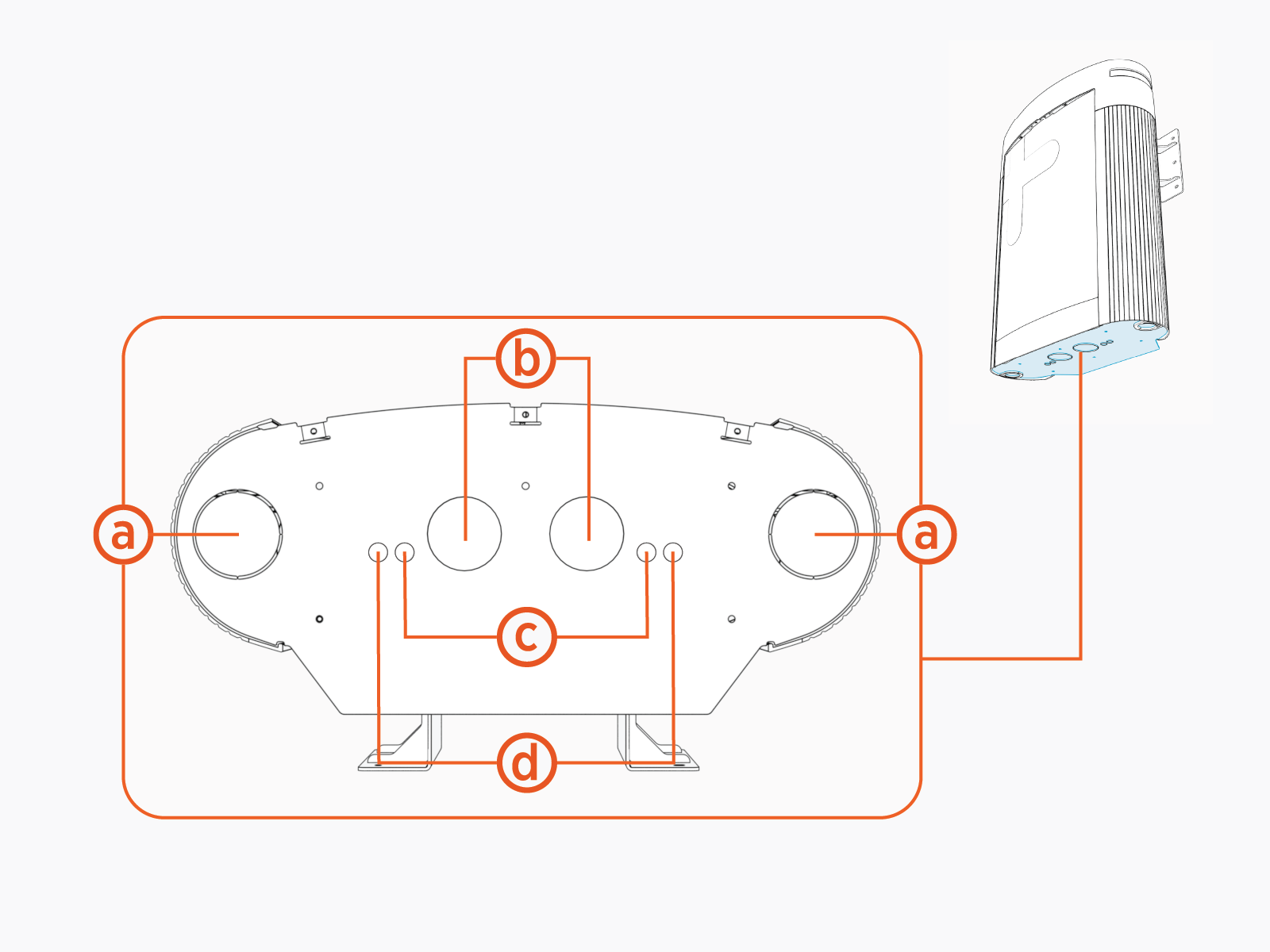
The overhead-mount Power Link 2000 ships with 3 inch (78 mm) conduit knockouts on the bottom gland plate, marked below as (a), for exit of HV DC High Voltage Direct Current output wires connecting to pantographs. All remaining wires enter the enclosure through the center area of the bottom gland plate.
High Voltage Direct Current input wire hole must be punched out on the gland plate at a location that aligns
wire entry with their intended power path landings. See Overhead-mount Power Link 2000 input wire landing.
-
HV
High Voltage DC output wire (to pantographs) exit with knockout cover -
HV DC
High Voltage Direct Current (from Power Blocks or connecting to another Power Link 2000) wire entry/exit -
LV DC
Low Voltage Direct Current and Ethernet (from Power Blocks or connecting to another Power Link 2000) wire entry/exit -
LV DC
Low Voltage Direct Current, Ethernet, and chassis ground (to PD Controllers) wire exit
| Conduits For | Conduit Quantity x Trade Size | |
|---|---|---|
| North America | Europe | |
|
HV (to pantographs) |
2 x 3 inch NOTE: 3 inch size conduit is required. The quantity of conduit will depend on the configuration. |
2 x 78 mm NOTE: 78 mm size conduit is required. The quantity of conduit will depend on the configuration. |
|
HV DC (from Power Blocks or connecting to another Power Link 2000) |
2 x 4 inch max. or 4 x 3 inch max. |
2 x 103 mm max. or 4 x 78 mm max. |
|
LV DC (from Power Blocks or connecting to another Power Link 2000) |
2 x 1 inch NOTE: 1 inch size conduit is required. The quantity of conduit will depend on the configuration. |
2 x 27 mm NOTE: 27 mm size conduit is required. The quantity of conduit will depend on the configuration. |
|
LV DC (to PD Controllers) |
2 x 3/4 inch NOTE: 3/4 inch size conduit is required. The quantity of conduit will depend on the configuration. |
2 x 21 mm NOTE: 17 mm size conduit is required. The quantity of conduit will depend on the configuration. |
|
Optional features (Ethernet to USB |
2 x 3/4 inch max. |
2 x 21 mm max. |
Overhead-mount Power Link 2000 input wire landing
High Voltage Direct Current input power paths, named A and B. Each power path has two wire landings, an upper landing and a lower landing. Pantograph Down 2000s with a single charging cable are configured with Power Path B landings only.
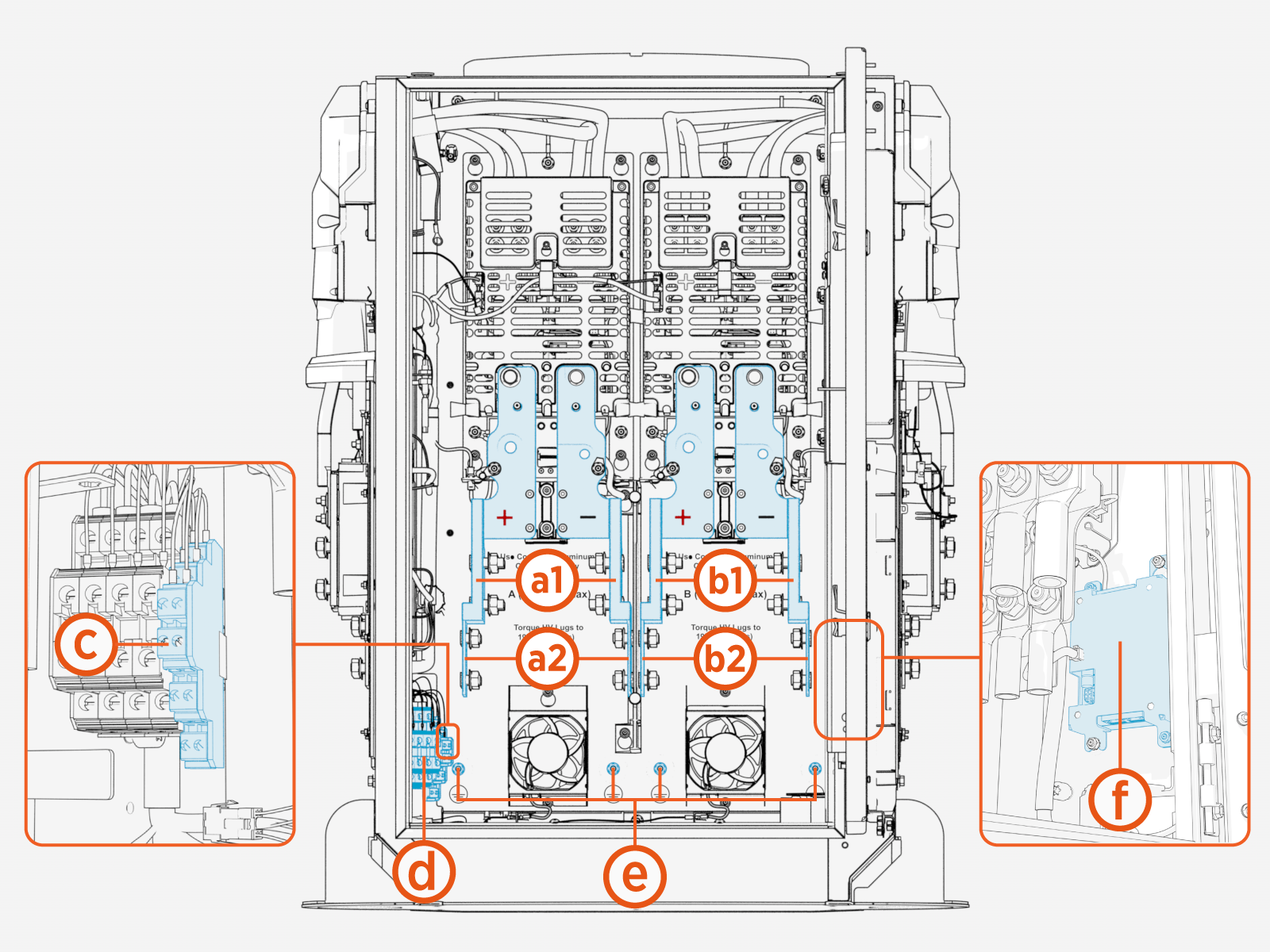
(a1) HV DC High Voltage Direct Current input A, upper landing
(a2) HV DC High Voltage Direct Current input A, lower landing
(b1) HV DC High Voltage Direct Current input B, upper landing
(b2) HV DC High Voltage Direct Current input B, lower landing
(c) Soft shutdown switch
(d) LV DC Low Voltage Direct Current input
(e) Ground input
(f) Ethernet input
Overhead-mount Power Link 2000 input wire quantity, size, and termination
|
Input Wire |
Quantity |
Size |
Termination |
|---|---|---|---|
|
HV DC A and B (Max. 500 A per landing) |
Max. 12 wires per Power Path (three per pole on each landing) |
Upper landings: Max. 150 mm2 (300 MCM)(*) |
Lug: Long barrel and tongue with two holes spaced 44.5 mm (1.75 in) apart and sized for M12 (0.5 in) studs. Max. tongue width: 31 mm (1.25 in) for upper landings, 25.9 mm (1 in) for lower landings. Aluminum lug max. tongue thickness: 10 mm (0.4 in) for upper landings, 5 mm (0.2 in) for lower landings. |
|
Lower landings: Max. 120 mm2 (4/0 AWG |
|||
|
Ground
|
Max. 6 wires (one per Power Block) |
Refer to local code for size; Max. 50 mm2 (1/0 AWG |
Lug: Short barrel and tongue with single hole and sized for M6 (0.25 in) stud. |
|
LV DC (from Power Block or another Power Link 2000) |
Max. 4 wires (two wire pairs; each pair has one wire per pole) |
16 mm2 (6 AWG |
Stripped wire end |
|
Ethernet |
Max. 4 cables |
Cat6 STP |
RJ45 connector |
|
Soft shutdown switch(***) |
2 wires |
2.5 mm2 (14 AWG |
Stripped wire end |
|
(*) If utilizing both upper and lower landings, the maximum HV DC
High Voltage Direct Current wire size is 120 mm2 (4/0 AWG American Wire Gauge). (**) The required Ethernet cable type depends upon the cable run length. |
|||
Overhead-mount Power Link 2000 output wire landing
The overhead-mount Power Link 2000 supports up to two HV DC High Voltage Direct Current outputs (L and R). Each output is the HV DC High Voltage Direct Current input for one pantograph. The pantographs are designated Pantograph L and Pantograph R, accordingly. The Power Link 2000 also outputs LV DC Low Voltage Direct Current, chassis ground, and Ethernet connection to each PD Controller paired with a pantograph.
The illustration below shows the landing locations for DC output wires connecting to Pantograph L and its paired PD Controller.

(aL) HV DC High Voltage Direct Current output L
(bL) High power ground L
(cL) LV DC Low Voltage Direct Current output L
(dL) Ethernet output L
(eL) Chassis ground output L
The illustration below shows the landing locations for DC output wires connecting to Pantograph R and its paired PD Controller.

(aR) HV DC High Voltage Direct Current output R
(bR) High power ground R
(cR) LV DC Low Voltage Direct Current output R
(dR) Ethernet output R
(eR) Chassis ground output R
Overhead-mount Power Link 2000 output wire quantity, size, and termination
|
Output Wire |
Quantity |
Size |
Termination |
|---|---|---|---|
|
HV DC L and R(*) |
Max. 12 wires (six per landing, three per pole) |
Max. 120 mm2 (4/0 AWG |
Lug: Long barrel and tongue with two holes spaced 44.5 mm (1.75 in) apart and sized for M12 (0.5 in) studs. Max. tongue width: 31 mm (1.25 in). Aluminum lug max. tongue thickness: 5 mm (0.2 in). |
|
High power ground (to pantograph PE and pantograph frame) |
Max. 4 wires (two per pantograph) |
Refer to local code for size; Max. 50 mm2 (1/0 AWG |
Lug: Short barrel and tongue with single hole sized for M6 (0.25 in) stud. |
|
LV DC (to another Power Link 2000) |
Max. 4 wires (two wire pairs; each pair has one wire per pole) |
16 mm2 (6 AWG |
Stripped wire end |
|
LV DC (to PD Controller) |
Max. 4 wires (one wire pair per PD Controller; each pair has one wire per pole) |
1.5 mm2 (16 AWG |
Stripped wire end or ferrule |
|
Chassis ground (to PD Controller) |
Max. 2 wires (one per PD Controller) |
4 mm2 (12 AWG |
Ring terminal: Sized for M6 (0.25 in) stud. |
|
Ethernet |
Max. 2 cables (one per PD Controller) |
Cat6 STP |
RJ45 connector |
|
(*) Each HV DC
High Voltage Direct Current output (L and R) can have a maximum of six HV DC High Voltage Direct Current wires (three per pole).
|
|||
PD Controller Wiring Specifications
Each PD Controller is configured with AC input from the site as well as LV DC Low Voltage Direct Current and Ethernet connections from a Power Link 2000.
For 120-277 V AC, 48 V DC, and ground wiring:
-
All wires must be housed in wireways that conform to national and local codes.
-
Use flexible wires.
-
Use suitable conduit fittings to secure and seal conduits. Conduits must be sealed to maintain a Pollution Degree 2 environment.
The PD Controller ships with a controller interface cable, a single cable that bundles the following cables for connection to a pantograph and Status LED:
-
Pantograph control pilot cable
-
Pantograph control cable
-
Pantograph rest sensor cable
-
Status LED cable
At full length, the controller interface cable allows a maximum distance of 5 m (16.4 ft) between the PD Controller and pantograph. If longer lengths are needed, contact ChargePoint. The controller interface cable may be cut to length.

Pantograph Down 2000 ships with two RF coaxial cables for connection to the Wi-Fi Wireless Fidelity and RFID Radio Frequency IDentification antennas. Each cable is 5 m (16.4 ft) long and cannot be cut to length. Custom cables of different length may be ordered for the site and must meet the cable specifications listed below. There is no minimum length bound.
| Cable | Maximum Length | Cable Type |
Termination A(*) |
Termination B(*) |
|---|---|---|---|---|
| Wi-Fi Wireless Fidelity antenna |
10 m (32.8 ft) | LMR-240 or equivalent, 6.1 mm (0.24 in) outer diameter, and low loss operating up to 5.8 GHz or higher. | RP-SMA male | N-type male |
| RFID Radio Frequency IDentification antenna |
10 m (32.8 ft) | LMR-240 or equivalent, 6.1 mm (0.24 in) outer diameter, and low loss operating up to 1 GHz or higher. | RP-SMA male | N-type male |
- The LMR-240 cable has a one-time bend radius of 19 mm (0.75 in) and repeated bend radius of 63 mm (2.5 in). If these are exceeded, the cable may be damaged and the system may not operate. If using an LMR-240 equivalent, do not violate the bend radius of that cable type.
- The RF coaxial cables may not be coiled within the PD Controller.
PD Controller wire entry
Wires enter at the PD Controller bottom panel by conduit or cable gland, as specified below. The enclosure ships with pre-made wire entry holes.
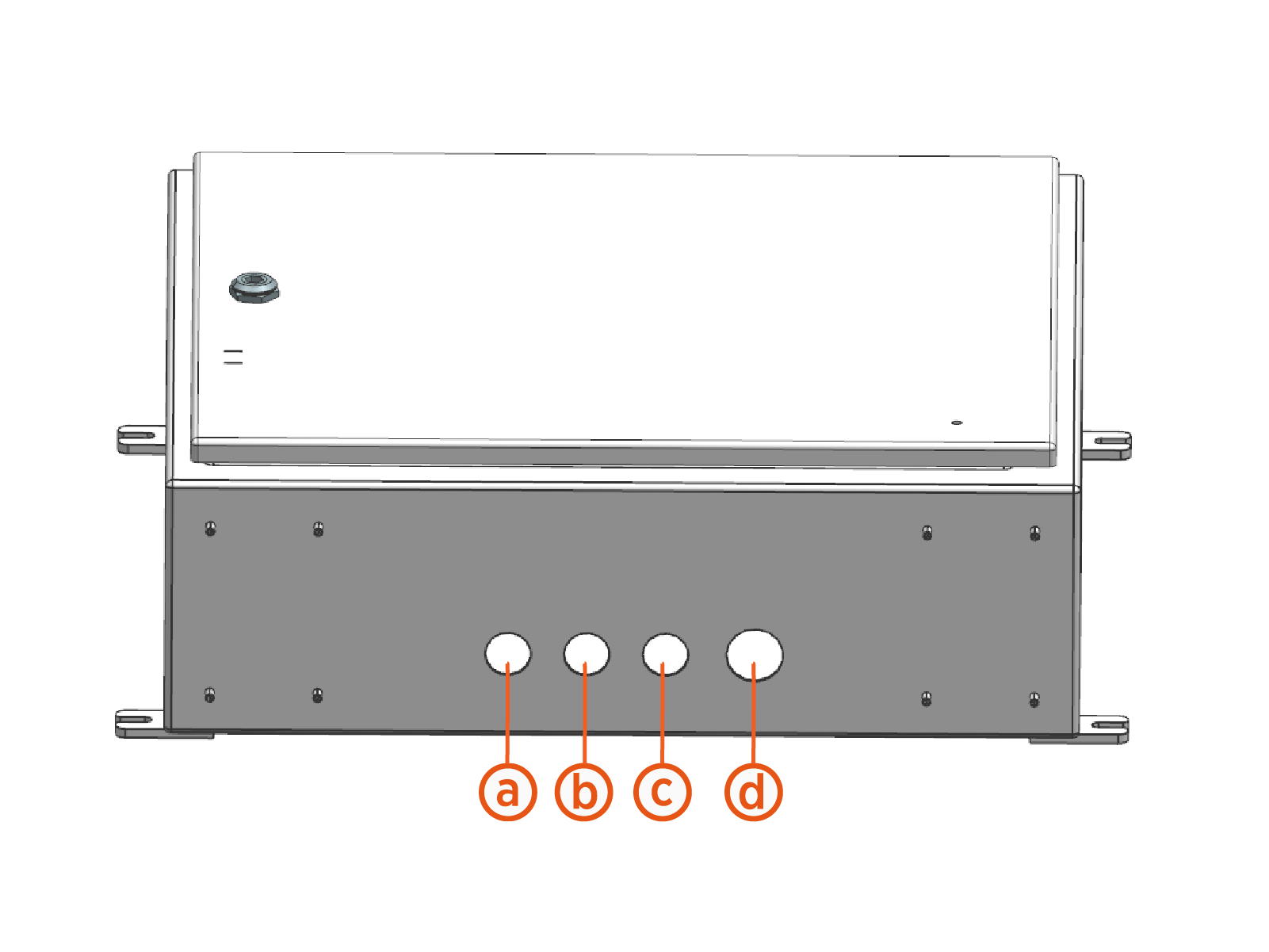
| Wire | Wire Entry Type | Required Size (Conduit Trade Size or Cable Gland) |
Required Quantity (Conduit or Cable Gland) |
|---|---|---|---|
|
(a) 120-277 V AC input wires from site |
Conduit required |
3/4 in (21 mm) |
1 |
|
(b) 48 V DC, Ethernet, chassis ground (from Power Link 2000) |
Conduit required |
3/4 in (21 mm) |
1 |
|
(c) RF coaxial cables to RFID |
Conduit or cable gland |
3/4 in (21 mm) |
1 |
|
(d) Controller interface cable |
Conduit or cable gland |
1-1/4 in (35 mm) |
1 |
The PD Controller ships with cable glands for the RF coaxial cables and controller interface cable. These are installed either at the PD Controller or at the end of the conduit run to the pantograph. The cable glands are 1-1/4 in (35 mm) and 3/4 in (21 mm) NPT National Pipe Thread.
PD Controller wire landing
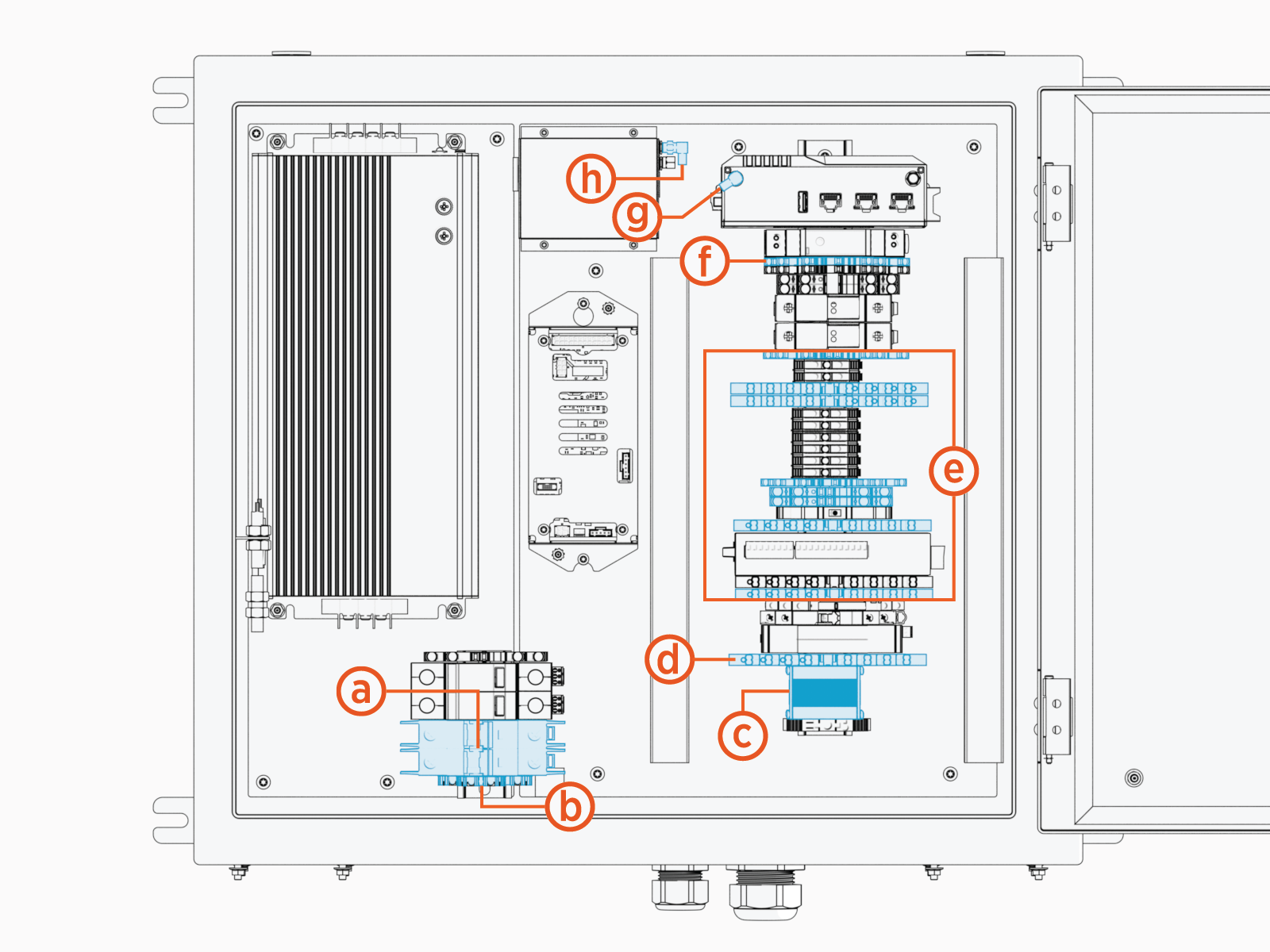
-
120-277 V AC input
-
AC PE
-
Ethernet input
-
Controller interface cable
-
Chassis ground
-
Wi-Fi
Wireless Fidelity antenna
PD Controller unfurnished wire quantity, size, and termination
Following are wire specifications for the PD Controller, including the maximum quantity and size that the wire terminals can accommodate. All sizing assumes a maximum ambient temperature of 50 °C (122 °F). Where the maximum wire size is listed, the actual wire quantity and size must be chosen based on site-specific wiring requirements and in accordance with the maximum allowed conduit filling rate per local code.
|
Wire |
Quantity |
Size |
Termination |
|---|---|---|---|
|
120-277 V AC input |
2 wires (one per pole) |
Size based on branch circuit breaker; Max. 16 mm2 (6 AWG |
Stripped wire end |
|
AC ground |
1 wire |
Size based on branch circuit breaker; Max. 16 mm2 (6 AWG |
Stripped wire end |
|
Stripped wire end |
|||
| Stripped wire end | |||
|
Ethernet input |
RJ45 connector, unshielded | ||
| Chassis ground | Stripped wire end | ||
|
* LV DC
Low Voltage Direct Current input wires are provided by ChargePoint if installing the PD Controller with the mast-mount Power Link 2000.
|
|||
Schunk SLS 201.102 Pantograph Wiring Specifications
Each pantograph is configured with HV DC High Voltage Direct Current and high power ground connection from a Power Link 2000. The pantograph also has controller interface cable connection to the PD Controller and a frame ground connection.
Schunk SLS 201.102 pantograph wire landing

-
High power ground (PE)
-
HV DC
High Voltage Direct Current input, positive (+) -
HV DC
High Voltage Direct Current input, negative (-) -
Control pilot
-
Rest sensor
-
Pantograph frame ground
-
Pantograph control
Schunk SLS 201.102 unfurnished wire quantity, size, and termination
|
Wire |
Max. Wire Quantity and Size |
Termination |
|---|---|---|
| Lug: Single hole lug and sized for M10 bolt. | ||
|
High power ground (PE) |
Lug: Single hole lug and sized for M10 bolt. | |
| Pantograph frame ground |
See Power Link 2000 output wire specifications See Power Link 2000 output wire specifications and Pantograph Down Mast wire specifications |
Ring terminal: Sized for M8 bolt. |
North American Wire, Voltage, and Current Ratings
|
|
Inputs to Power Block |
Power Block to Each Power Link 2000 |
|||
|---|---|---|---|---|---|
|
|
AC and Ground |
Shunt Trip |
HV DC Output |
48 V DC Output |
Ethernet |
|
Circuit Voltage |
480 V AC |
≤ 240 V |
100-1000 V |
48 V |
— |
|
Max. Current |
260 A |
6 A |
200, 250, 350, or 500 A |
32 A |
— |
|
Notes |
Rated for 600 V L1, L2, L3, Ground |
|
Rated for 1000 V |
Outdoor rated |
|
|
(*) The required Ethernet cable type depends upon the cable run length. See Ethernet requirements.
|
|||||
|
|
Inputs to PD Controller |
Power Link 2000 to Each Pantograph |
Power Link 2000 to each PD Controller |
||
|---|---|---|---|---|---|
|
|
120-277 V AC Input |
48 V DC Output |
Ethernet |
||
|
Circuit Voltage |
120 V AC | 208-277 V AC |
100-1000 V |
48 V |
— |
|
Max. Current |
4 A | 2 A |
200, 250, 350, 400, or 500 A |
6 mA |
— |
|
Notes |
Rated for 600 V, 50/60 Hz, single phase |
Rated for 1000 V |
Outdoor rated |
||