Site Design Guidelines
Initial Site Guidelines
Designing electrical infrastructure to support current and future EV Electric Vehicle charging demand can help avoid costly upgrades later as EV Electric Vehicle adoption grows.
Complete an on-site evaluation to determine conduit and wiring requirements from the panel to the proposed parking spaces, as well as to measure cellular signal levels and identify suitable locations for any necessary cellular signal booster equipment.
If you have pre-existing infrastructure or are using your own preferred electrical contractor to prepare your site, a Construction Signoff Form by a ChargePoint Operations and Maintenance (O&M) partner is required to certify compliance with electrical code, and to ensure everything was prepared to ChargePoint specifications.
- If the charging station is not installed, commissioned, or serviced by a ChargePoint certified technician using a ChargePoint-approved method, it is excluded from all ChargePoint and other warranties and ChargePoint is not responsible.
- You must be a licensed electrician and complete training at https://www.chargepoint.com/partners/training-certification to become ChargePoint certified and to access ChargePoint's web-based installer tools or ChargePoint Installer app.
Plan for the Future
Consider current EV Electric Vehicle charging needs and also potential future needs as EV Electric Vehicle adoption grows.
-
Consider running raceway or conduit to all planned EV
Electric Vehicle parking spots and pulling electrical wiring from the panel to meet current needs. -
Consider installing a dedicated electrical panel for EV
Electric Vehicle charging and leveraging ChargePoint Power Management. This efficiently uses available power at a site to support more EV Electric Vehicle charging ports than would otherwise be possible.
Charging Station Placement
To help minimize costs, choose station locations that are as close as possible to the available electrical infrastructure. Selecting these types of locations helps minimize long conduit and wire runs, as well as any trenching work.
Layout Considerations
To ensure a successful and cost effective installation of CP6000 charging stations, the following layout factors should be carefully evaluated:
-
Identify station locations for EV
Electric Vehicle charging spots. -
CP6000 charging stations can be installed either indoors or outdoors.
-
They can be mounted on walls or in the ground (pedestal mount).
-
CP6000 charging stations do not have an integrated active ventilation system.
-
To help minimize costs, choose station locations that are as close as possible to the available electrical infrastructure.
-
Consider locations where it will be easy to add future stations.
-
Consider how easily drivers can find the stations they need to access.
-
Identify suitable locations with smooth, plumb surfaces for wall mount stations or suitable floor surfaces for pedestal mount stations.
-
Consider a layout to minimize electrical infrastructure costs to all proposed EV
Electric Vehicle parking spaces. -
Avoid or minimize trenching requirements.
-
Comply with regional accessibility laws, regulations, and ordinances. The charging station must not block ramps or pathways and the height of the interactive display cannot exceed the maximum height as dictated by local laws.
-
For stall parking, ChargePoint recommends using perpendicular parking stalls to better accommodate EVs with front and rear charge ports.
-
Use dual-port pedestal mount stations where possible in open areas for adjacent parking or adjoining parking spaces.
-
Consider protective bollards and wheel blocks where appropriate, especially for open tandem parking spaces.
-
If the charging station has a camera, orient the camera towards the parking space.
-
Use professional cellular test equipment to measure cellular signal levels to ensure adequate cellular coverage at the station installation location. To ensure adequate signal strength in underground or enclosed parking structures, cellular repeaters may be required. Use an indoor antenna located near EV
Electric Vehicle parking spaces and an outdoor antenna typically located at the garage entrance ceiling or on the rooftop where cellular signals are best. See Connectivity for more details. -
When the charging stations cannot be placed close enough to the source of power to avoid undesirable line losses, consider increasing the size of the conductors. When the circuit conductors must be larger than 25 mm2, you must add a disconnect immediately adjacent to the station and terminate the upsized conductor at the line side lug of the disconnect. Then, connect a short length of 25 mm2 conductor to the load side lug of the disconnect and the station. Adding disconnects close to the stations is also helpful when the circuit breakers are relatively far away.
-
If you are installing a CP6000 pedestal mount charging station with a CMK
Cable Management Kit and a 10m cable, ensure there is at least 2.8 m (108 in) (a) of clear space behind the station location for the CMK Cable Management Kit to rest on the ground.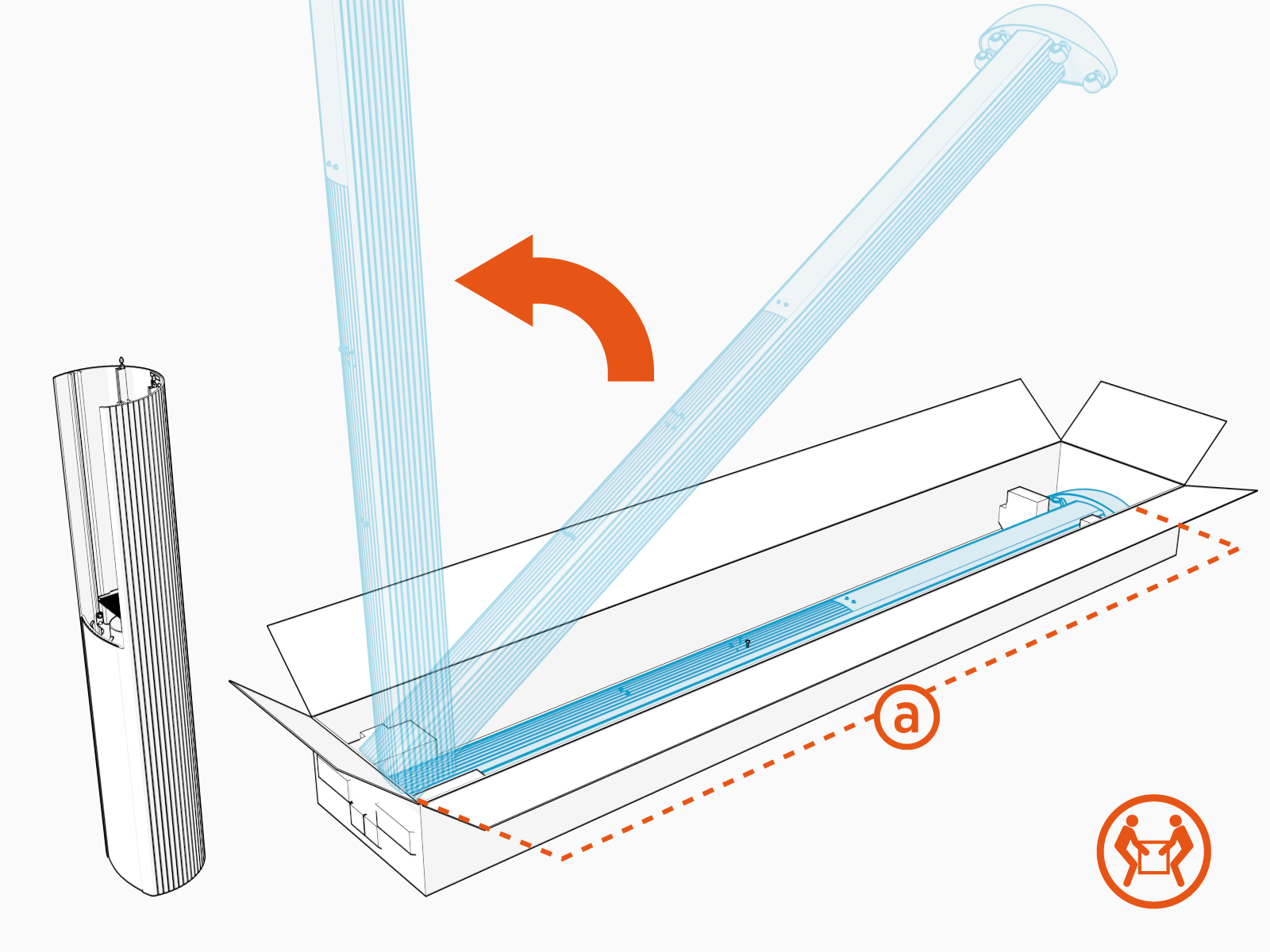
-
If you are installing a CP6000 wall mount charging station with a CMK
Cable Management Kit and a 10m cable, ensure there is at least 2.8 m (108 in) of clear space in front of the station location for the CMK Cable Management Kit to rest on the ground.
Pedestal Base Designs
There are three basic pedestal base designs:
-
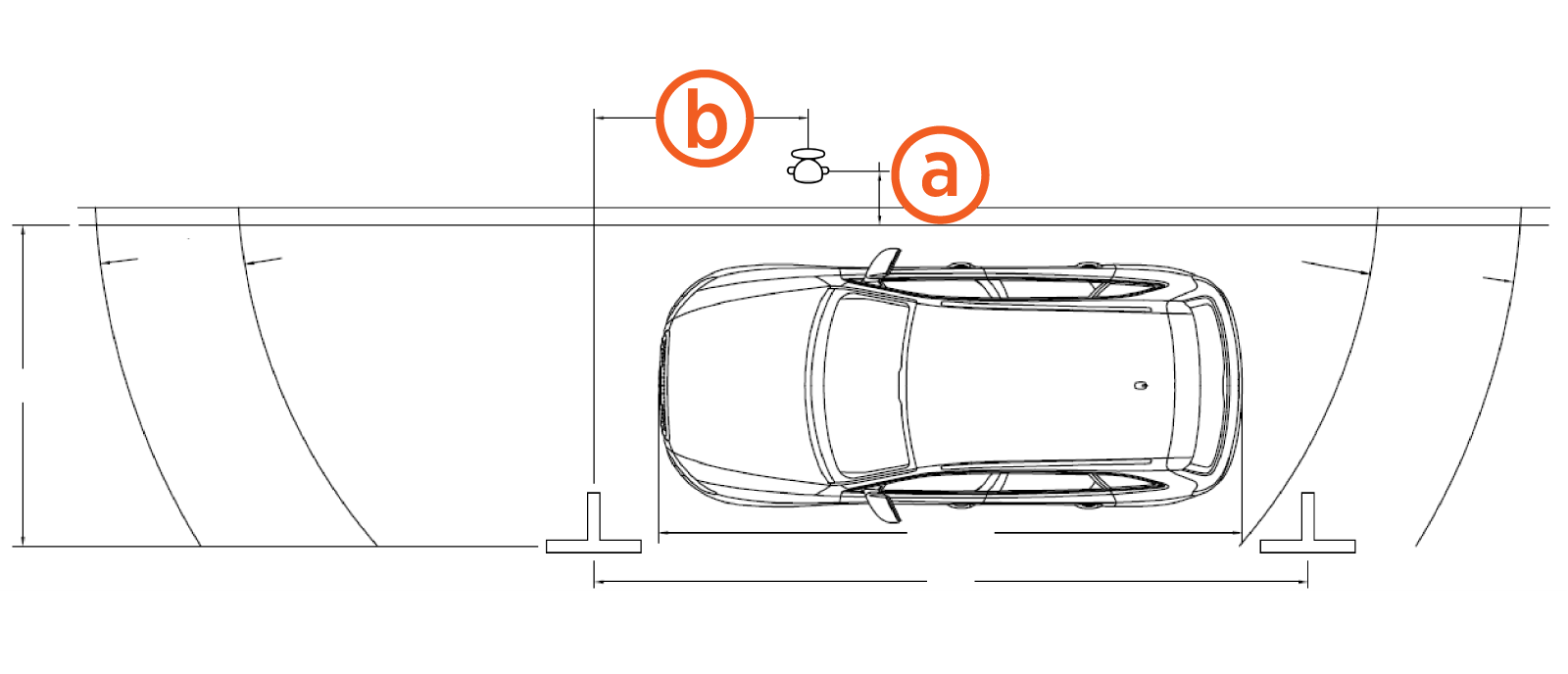
In front of a curb (a) - Does not obstruct a pedestrian pathway or disturb landscaping.
900 mm (3 ft) on each side (b)
Area: 0.42 m2 (4.5 ft2)
Volume: 0.26 m3 (9 ft3)

-
Behind a curb (a) in a planter or berm
1350 mm (4 ft 5 in) on each side
Area: 0.37 m2 (4 ft2)
Volume: 0.23 m3 (8 ft3)
Use a retaining wall as needed to prevent dirt from accumulating on the pad.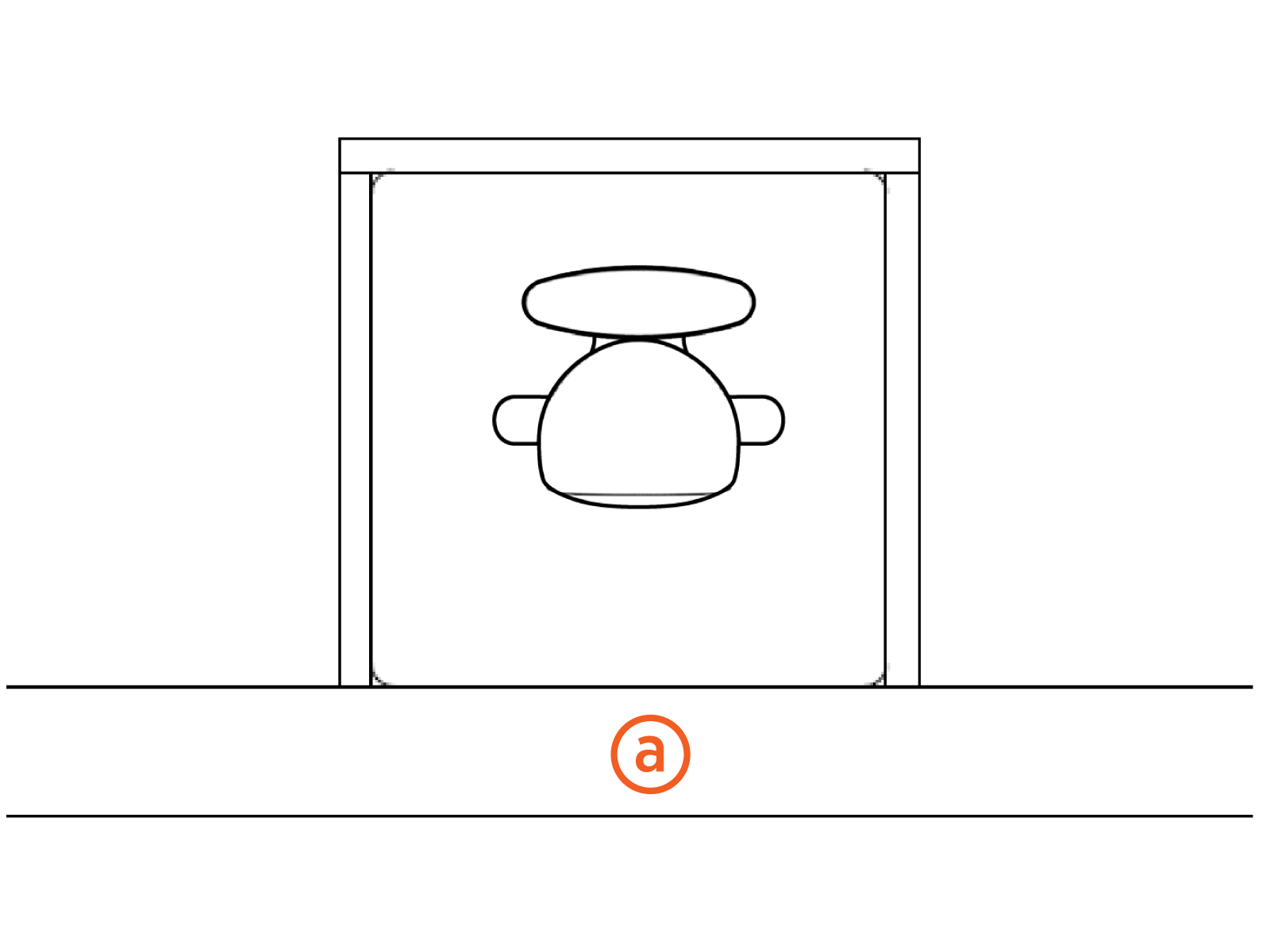
-
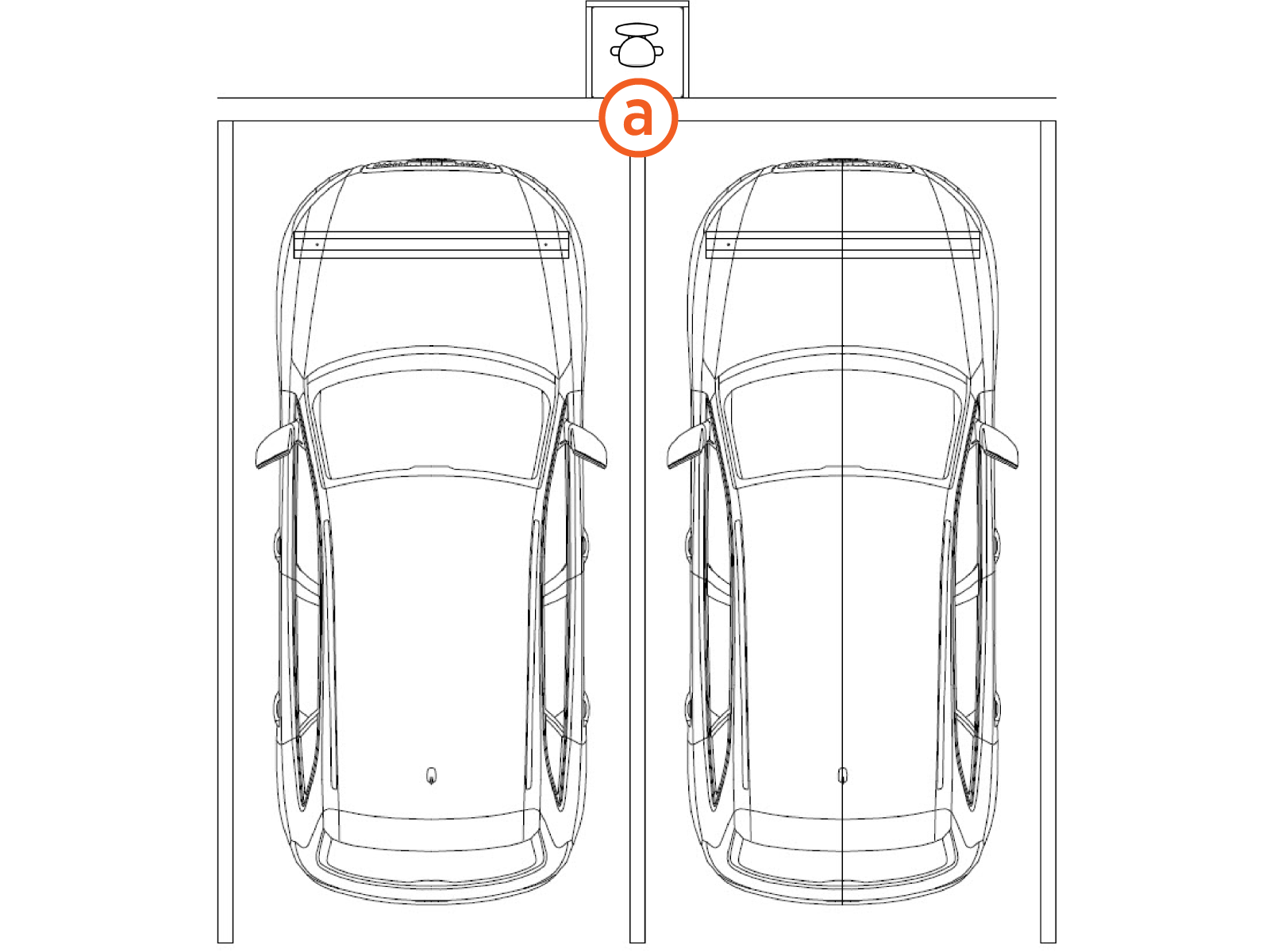
Two stations back to back, centered between four spaces 900 mm (3 ft) on each side
Area: 0.84 m2 (9 ft2)
Volume: 0.51 m3 (18 ft3)

Pedestal Configurations for Different Parking Arrangements
The pedestal base design can be configured in a variety of ways to serve different parking arrangements. Ensure a sufficient volume of concrete to provide anchoring for the charging station.
-
Place the station against the curb between spaces with wheel stops 900 mm (3 ft) from the front of each stall. The base of the charging station can be flush with the parking spaces or at curb level.

-
Place the station in a planter or berm between spaces with wheel stops 900 mm (3 ft) from the front of each stall or the curb (a).
-
Place two stations back to back centered on four spaces with wheel stops 900 mm (3 ft) from the front of each stall. The base of the charging station can be flush with the parking spaces or at curb level.

-
When placing a dual holster station centered on the right space, the charging cables can reach two vehicles. Place a wheel stop 1220 mm (4 ft) (a) from the center of the charging station.
Note the following details for this arrangement:
-
The arc shows the usable reach of the two charging cable lengths available: 5.5 m (18 ft) (b), 7 m (23 ft) (c), and 10 m (31 ft) (d).
-
The 7 m (23 ft) cord option is recommended for this configuration.
-
The base of the charging station can be flush with the parking spaces or at curb level.
-
Ensure to install 'EV
Electric Vehicle Charging Station' signs on both spaces.

-
-
Place a dual holster station centered between two parallel parking spaces, each 6 m (20 ft) long. Place the station (a) 450 mm (18 in) from the curb. A 7 m (23 ft) charging cable is recommended.

-
Place a single holster station for a single parallel parking space 6 m (20 ft) long. Place the station (a) 450 mm (18 in) from the curb, and 1.8 m (6 ft) from the front of the parking space (b) This allows the cord to reach any part of the vehicle without blocking the curb side doors.