Electrical Design
Electrical Requirements
At a minimum, each AC charging station, either single or dual port, requires the following:
-
A dedicated single phase or three phase electrical circuit from 20 A to 63 A
-
A new circuit breaker at the electrical panel
-
Conductor wiring and circuit protection sized in accordance with all applicable codes
Consequently, a CP6000 charging station with two charge ports typically requires two power input circuits, one circuit per port. There may be situations where both ports share a main single circuit. If power capacity is limited at a site or to reduce costs for electrical infrastructure, consider ChargePoint Power Management options for power sharing at the circuit level, panel level, transformer, or site level.
Additional Electrical Considerations
In addition to the minimum electrical requirements, consider the following factors to ensure a safe and compliant installation:
-
CP6000 charging stations are AC electrical vehicle (EV
 Electric Vehicle) supply equipment and are permanently connected to AC networks.
 -
Evaluate existing electrical infrastructure to determine if the existing utility service and electrical panel capacity is sufficient.
-
Ensure appropriate electrical wiring, over current circuit protection, and metering, if required, is in place.
-
Identify costs for any necessary upgrades and/or a new dedicated electrical panel.
-
ChargePoint recommends using a licensed electrician to evaluate available capacity and identify any upgrades that may be required.
-
If a dedicated EV
Electric Vehicle electrical panel is required, choose a panel location in close proximity to the charging stations. -
Determine raceway or conduit runs for electrical wiring from the electrical panel.
-
Of the four different modes of charging, CP6000 charging stations operate in charging mode 3 (use an EV
Electric Vehicle connector).
CP6000 wall mounted charging stations use surface mount wiring. CP6000 pedestal mounted charging stations typically require service wiring installed underground to enter through the bottom of the station.

Attach the conduit with a listed fitting. Use a sealing method that meets all applicable code requirements.
Conduit and wire size are determined based on the length of runs from the electrical panel to the station location. Service wiring must be run through conduit to comply with local electrical codes. Consult national and local codes or a project engineer to determine the grade, quality, and size of the conduit or cable. The CP6000 Concrete Mount Kit accommodates service wiring through the flare, conduit, or locally appropriate wiring method.
Electrical Supply Requirements
Wiring must be sized in accordance with all applicable codes for continuous load devices. The main standard for cable size is based on IEC 60364-5-52:2009 and IEC 60364-5-54:2011. The terminal block accepts stranded or solid conductors up to 25 mm2. The appropriate size depends upon the distance between the electrical panel and the charging station installation site and the maximum current in the circuit.
When planning multiple EV Electric Vehicle charging stations, it is best practice to separate non-continuous from continuous loads, with all branch circuits for EV Electric Vehicle charging on a dedicated electrical panel assembly with adequate circuit breakers. When sizing new electrical panels dedicated for EV Electric Vehicle charging, all branch circuits must support continuous load.
CP6000 charging stations are designed for connection and operation on rated voltages of 230 V +/- 10% (line to neutral) or 400 V +/- 10% (line to line) at 50 Hz.
Note these important details before installing the charging station. CP6000 charging stations include:
- Protection against electric shock provided by a Type A RCD Residual Current Device, 30 mA, with an RCCB Residual Current Circuit Breaker or an RCBO Residual Current Breaker with Overload Protection option.
- Protection against short-circuit:
- If CP6000 with RCCB Residual Current Circuit Breaker configuration is selected, short-circuit protection is installed upstream in the installation.
- If CP6000 with RCBO Residual Current Breaker with Overload Protection configuration is selected, short-circuit protection is included for each charging point with Curve C type and a rated short-circuit capacity of 6 kA.
- If CP6000 with RCCB
-
Additional protection against 6 mA DC current according to applicable clauses of the IEC 62955:2018 per each output
-
Overcurrent protection: The CP6000 will open the circuit in the event of an overcurrent above 1.25 times the rated current within 10 seconds
-
Electrical Class B meter according to 2014/32/EU Measuring Instrument Directive
-
CP6000 charging stations comply with Class A electromagnetic immunity for industrial environments and Class B electromagnetic emissions for non industrial environments according to IEC 61851-21-2:2018.
-
Pollution degree III (for external use)
-
Indoor and outdoor installations
-
IP56 rated
-
Standard CP6000 charging stations might not be suitable for accessible locations due to reduced IP and IK degree.
-
IK10 rated
-
Equipment intended for use by the general public
-
Equipment that can be installed in locations with non-restricted access
-
Ventilation function is not supported
-
CP6000 charging stations are installed with the following options:
-
Case C - EN 62169-1 Type 2 EV
Electric Vehicle connector cables attached -
Case B - EN 61269-1 Type 2 socket outlet (bring your own cable)
-
Case B - EN 62169-1 Type 2 shuttered socket outlet (bring your own cable).
When installing case C EV Electric Vehicle supply equipment, the vehicle connector must be between 0.5 m and 1.5 m above ground when stored.
-
-
Charging connector adapters should not be used when charging with CP6000 charging stations
-
CP6000 charging stations are designed to operate within a temperature range from -30° C to 50° C
Be aware of these requirements before installing the charging station:
-
CP6000 is Class I equipment. Power supply must provide a PE conductor and the unit must be grounded. The charging station must always be connected to protective earth (PE).
-
Reserve a power source exclusively for the charging station and ensure that it complies with HD 60364-7-722:2018.
-
Upstream short circuit protection should be either one of the following:
-
Fuse type gG, all 4 poles, with at least 6 kA lcc
-
MCB
Miniature Circuit Breaker, 4 poles, curve C, with a nominal current greater than or equal to the maximum current expected (at least 6 kA lcc)
-
-
CP6000 power input supply must always be provided with a neutral conductor.
Consult your electricity grid operator regarding requirements for local regulations. Depending on the desired rated power, the installation of the charging station may require registration with and/or approval by your electricity grid operator.
Conduit
The outside diameter of conduit must not exceed the sizes called out in the pedestal mounting template: 95 mm (3.74 in). Conduit stub-ups must measure between 150 mm (6 in) and 590 mm (23.25 in) above grade.
Conduit stub-ups must not extend higher than 600 mm above ground level.
For wall mounted stations, flex conduit can be used to bring the wire to the station.
Armored Cable
For pedestal mounted stations, trim duct to concrete level. Approximately 1.5 m (5 ft) of armored cable (service wiring) must extend above the concrete surface.
For wall mounted stations, flex conduit can be used to bring wire to the station.
Wiring Requirements
For full product specifications, refer to the CP6000 Datasheet. Using that data, ensure that the installation location is equipped with service wiring that supports the charging station’s power requirements.
When pulling electrical wiring for CP6000 pedestal mount, ensure at least 1.5 m (5 ft) of wire remains above grade. When pulling electrical wiring for wall mount stations, the conduit and wire must be brought to the location where the stations will be mounted. Flex conduit is typically used to bring the wire to the station. Wiring is brought in through knock outs in the bottom of the charging station.
Electrical Input
The charging stations support flexible power settings up to 7.4 kW (32 A single-phase) or 22 kW (32 A three-phase) service per output. Input can be up to 14.7 kW (63 A single-phase) and 44 kW (63 A three-phase) considering single input - dual output.
Power Select allows stations to be installed and configured for power lower than the maximum rating.
Circuit Share allows a dual-port station to share power from a single supply circuit across two ports, adjusting power depending on whether one or both ports are charging. Standard wiring uses an independent circuit for each port. Circuit Share can be used in combination with Power Select.
-
Electrical input
-
Electrical output
-
Mounting and functional interfaces
-
Safety and connectivity features
-
Safety and operational ratings
UK Requirements
There are specific requirements for EV Electric Vehicle charging station installations within the UK. In most of the locations, the installation type follows a TN-C Terra Neutral Combined-S scheme (PME supply) which, according with the general standards for EV Electric Vehicle charging stations, is not allowed. CP6000 stations follow all the relevant safety requirements in accordance with IEC 61851-1:2018 and IEC 60364-7-722. Any extra safety requirement caused by the installation type must be discussed with the Distribution Network Operator (DNO).
CP6000 station includes an RCCB Residual Current Circuit Breaker or RCBO Residual Current Breaker with Overload Protection that will open power lines (phase 1, phase 2, phase 3, and Neutral) in the event of a failure.
CP6000 is a Class 1 product. All metallic parts accessible are connected to the main earth terminal. Installation of the earth connection to the EV Electric Vehicle charging station is required.
CP6000 charging stations are designed to be installed on a TN-S Terra Neutral Separate system and can be installed on TT earth systems.
Terra Neutral Separate type shall be considered as TN-C Terra Neutral Combined-S type.Following BS 7671-7-722, clause 722.411.4, ChargePoint CP6000 charging stations must not be installed in a TN-C Terra Neutral Combined-S or Protective Multiple Earthing (PME) facility if the CP6000 charging station is located outdoors or the charging station is indoors but the EV Electric Vehicle will be parked outdoors, unless one of the clauses (i) to (v) of BS 7671-7-722, clause 722.411.4 are fulfilled.
CP6000 charging stations do not include a PME detection and protection system; therefore, unless clause (i) or (ii) can be guaranteed, an external device capable of providing that detection and protection and opening all live conductors, including the PE conductor, within 5s from the moment the fault is detected, must be installed.
In addition, if it is necessary to create a TT earth system, the main ground lug point (a) located in the CP6000 can be used as a connection point to the earth rod. The impedance of the TT system shall be such that the voltage between the exposed conducted parts or the earth of the installation and true earth cannot exceed 70 Vrms.

Standard Wiring Options
-
All stations ship with an L1 - L2 power jumper. The power jumper is not installed in the factory.
-
For any other rated power recommended by national laws, check the national wiring and breaker codes to select the rating of the breaker.
For assistance, go to chargepoint.com/support and contact technical support using the appropriate region-specific number. Order power management jumpers from Support if required.
CP6000 charging stations comes with two options:
Residual Current Circuit Breaker (RCCB
Residual Current Circuit Breaker) per charging port orResidual Circuit Breaker with Overload Protection (RCBO
Residual Current Breaker with Overload Protection) per charging port
Talk to your local ChargePoint contact and agree on the best solution for the installation.
When choosing RCBO Residual Current Breaker with Overload Protection, a single input cable can be supplied to the charging station because of the share power management jumpers. The upstream cable will also be protected according to the national wiring regulations.
When choosing RCCB Residual Current Circuit Breaker in certain countries, local wiring regulations will require that these stations shall be connected with two input power cables and an additional upstream Miniature Circuit Breaker (MCB Miniature Circuit Breaker). Make sure to follow the local regulations considering the maximum current delivered per charging port.
If an upstream RCD Residual Current Device will be used, ensure that the RCD Residual Current Device fulfills the selectivity criteria. Either 30 mA (s) with selective tripping characteristic or 100 mA are required so both RCDs (RCCB Residual Current Circuit Breaker in station and RCD Residual Current Device in upstream circuit board) will be connected in series.
230/400 Three Phase Dual Circuit, Dual Port
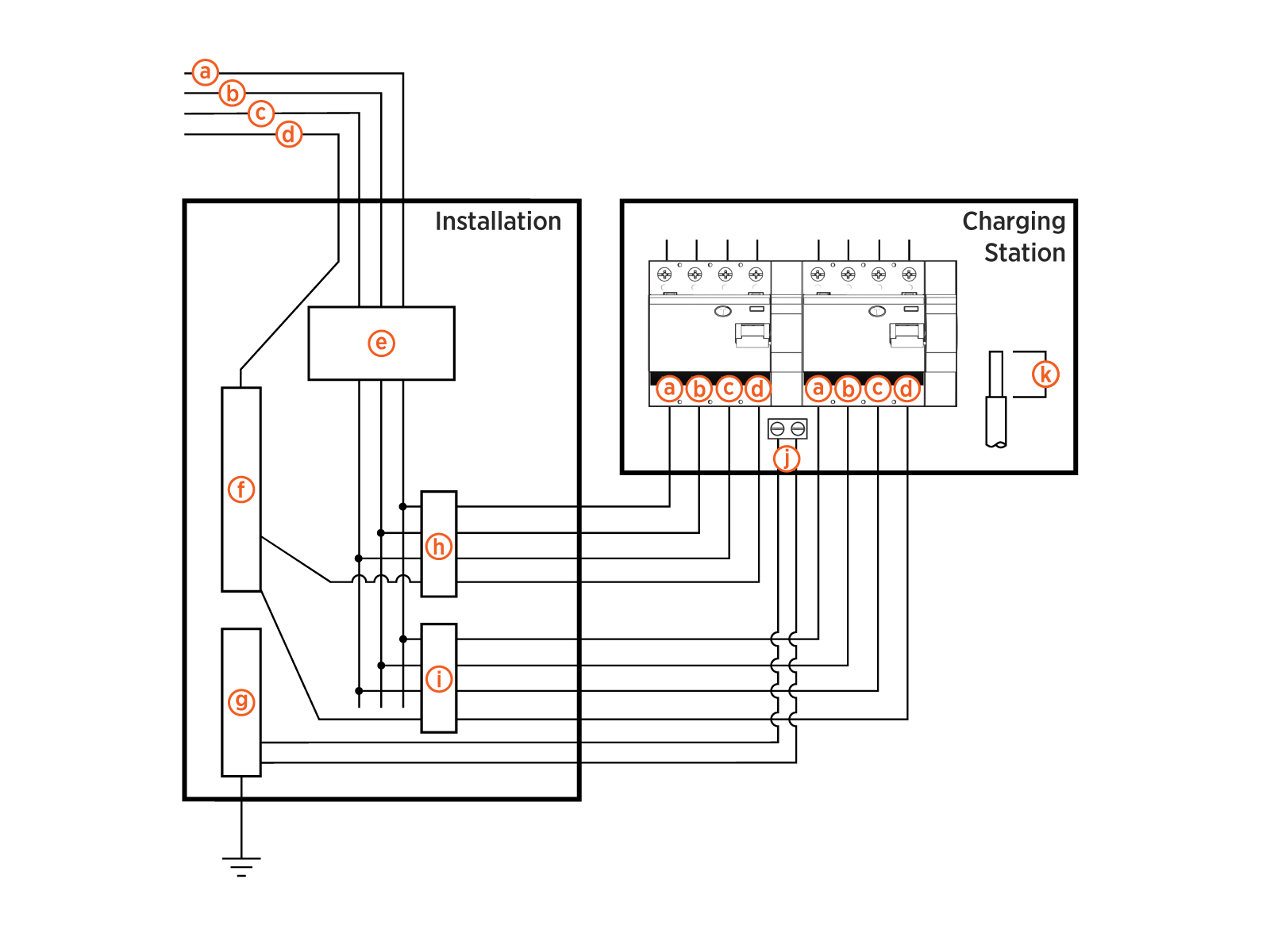
(a) L3
(b) L2
(c) L1
(d) Neutral
(e) Main breaker
(f) Neutral bus
(g) Ground bus
(h) Left breaker
(i) Right breaker
(j) Ground
(k) Wire strip length 12 mm (0.5 in)

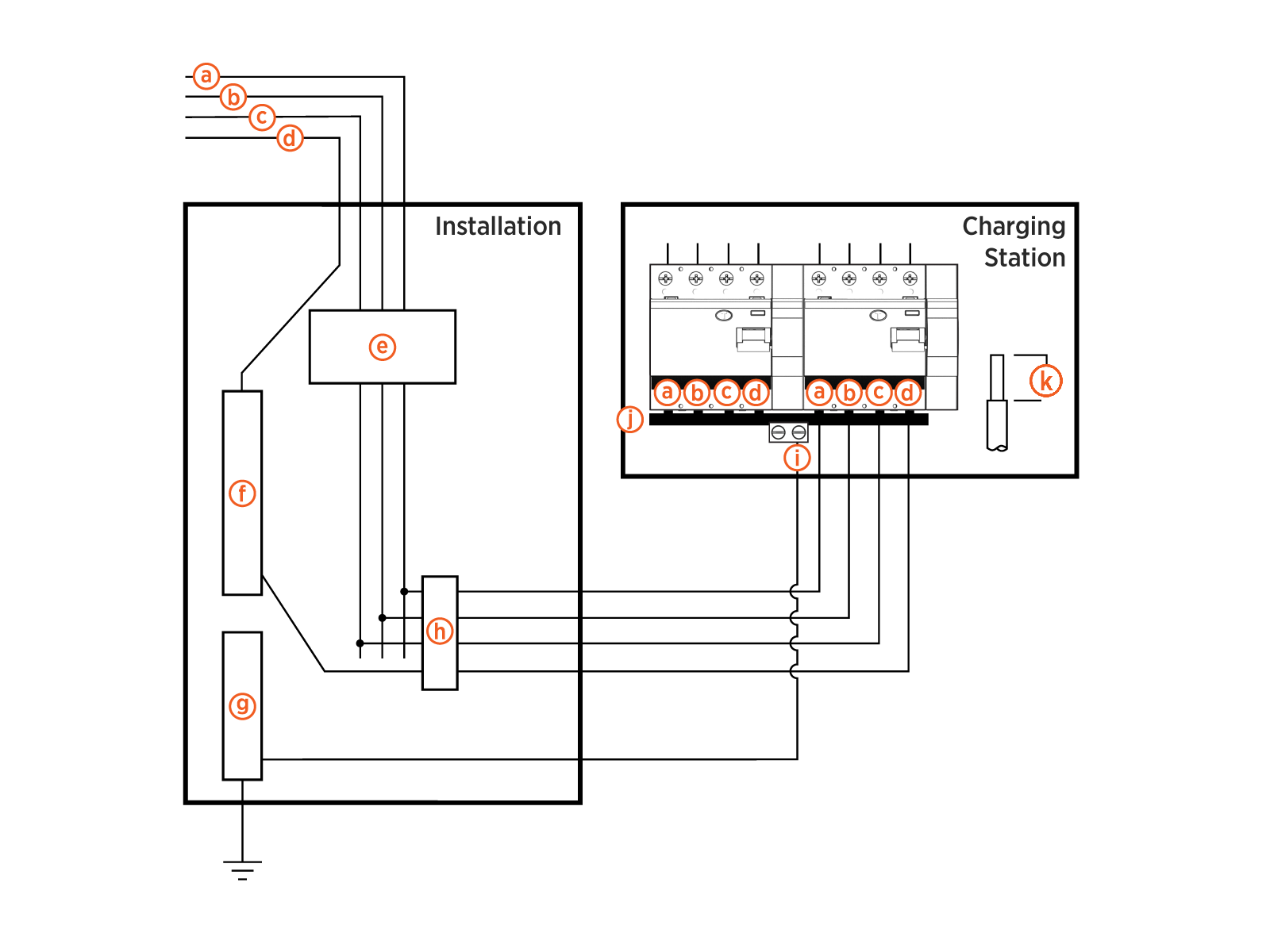
230/400 Three Phase Single Circuit, Single Port

(a) L3
(b) L2
(c) L1
(d) Neutral
(e) Main breaker
(f) Neutral bus
(g) Ground bus
(h) Breaker
(i) Ground
(j) Wire strip length 12 mm (0.5 in)

Circuit Sharing Wiring (Dual Port Station Only)
To power a dual-port station using a single power cable, use the circuit share jumper. The L1 - L2 circuit share jumper is included with each CP6000. Circuit sharing is available only for dual-port station configurations.
Technically, CP6000 charging stations can be connected with either one or two input cables; however, the charging stations do not integrate a Residual Current Circuit Breaker with Overload Protection (RCBO Residual Current Breaker with Overload Protection), but rather a Residual Current Circuit Breaker (RCCB Residual Current Circuit Breaker) per charging port.
In certain countries, local standards require that these stations be connected with two input cables and an upstream Miniature Circuit Breaker (MCB Miniature Circuit Breaker) or an MCB Miniature Circuit Breaker combined with a residual current device (RCD Residual Current Device) protecting each charging port. If you need an RCBO Residual Current Breaker with Overload Protection, contact ChargePoint Support at chargepoint.com/support .
Be sure to follow the local standards before deciding to install the station with one input cable.
|
Phases |
Maximum current per output (A) |
Number of outputs |
Maximum current input (A) |
Power input (kW) |
Breakers required |
Minimum panel size for single input (A) |
Minimum panel size for dual input (A) |
|---|---|---|---|---|---|---|---|
|
Single |
16 |
1 |
16 |
3.7 |
1 |
20 |
n/a |
|
Single |
20 |
1 |
20 |
4.6 |
1 |
25 |
n/a |
|
Single |
25 |
1 |
25 |
5.8 |
1 |
32 |
n/a |
|
Single |
32 |
1 |
32 |
7.4 |
1 |
40 |
n/a |
|
Single |
16 |
2 |
32 |
7.4 |
1 or 2 |
40 |
20 |
|
Single |
20 |
2 |
40 |
9.2 |
1 or 2 |
50 |
25 |
|
Single |
25 |
2 |
50 |
11.5 |
1 or 2 |
63 |
32 |
|
Single |
32 |
2 |
63 |
14.5 |
1 or 2 |
63 |
40 |
|
Three |
16 |
1 |
16 |
11.0 |
1 |
20 |
n/a |
|
Three |
20 |
1 |
20 |
13.8 |
1 |
25 |
n/a |
|
Three |
25 |
1 |
25 |
17.3 |
1 |
32 |
n/a |
|
Three |
32 |
1 |
32 |
22.1 |
1 |
40 |
n/a |
|
Three |
16 |
2 |
32 |
22.1 |
1 or 2 |
40 |
20 |
|
Three |
20 |
2 |
40 |
27.6 |
1 or 2 |
50 |
25 |
|
Three |
25 |
2 |
50 |
34.5 |
1 or 2 |
63 |
32 |
|
Three |
32 |
2 |
63 |
44.2 |
1 or 2 |
63 |
40 |
|
Three |
32 |
2 |
80 |
44.2 |
1 or 2 |
80 |
40 |
230/400 Three Phase Single Circuit, Dual Port
(a) L3
(b) L2
(c) L1
(d) Neutral
(e) Main breaker
(f) Neutral bus
(g) Ground bus
(h) Breaker
(i) Ground
(j) Jumper
(k) Wire strip length 12 mm (0.5 in)
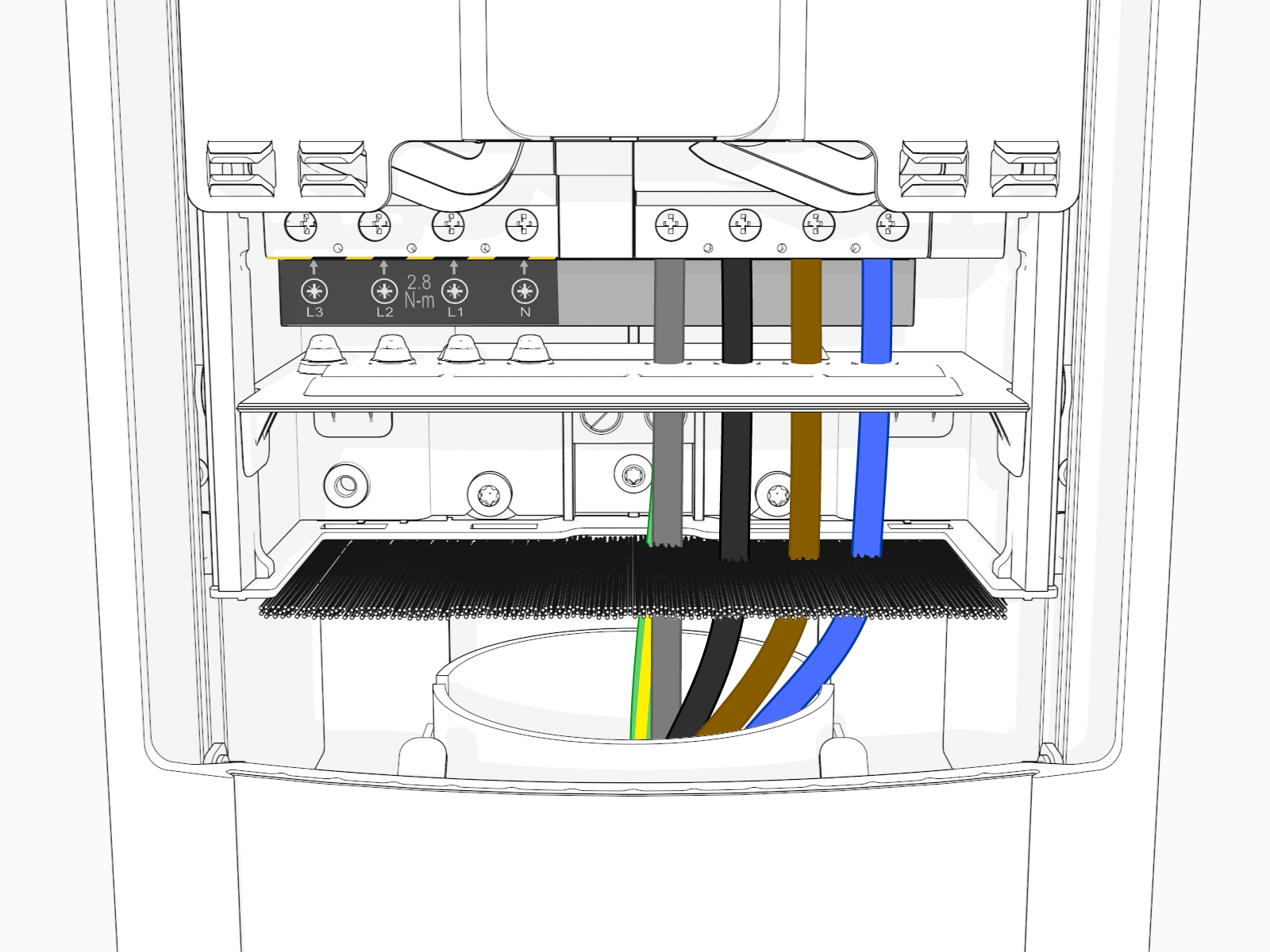
Residual Current Circuit Breaker or RCBO Residual Current Breaker with Overload Protection option. Contact ChargePoint Support for guidance and follow the local national regulations.
230 Single Phase Single Circuit, Dual Port

(a) L1
(b) Neutral
(c) Main breaker
(d) Neutral bus
(e) Ground bus
(f) Breaker
(g) Ground
(h) Jumper
(i) Wire strip length 12 mm (0.5 in)

230 Single Phase Dual Circuit, Dual Port

(a) L1
(b) Neutral
(c) Main breaker
(d) Neutral bus
(e) Ground bus
(f) Left breaker
(g) Right breaker
(h) Ground
(i) Wire strip length 12 mm (0.5 in)

230 Single Phase Single Circuit, Single Port
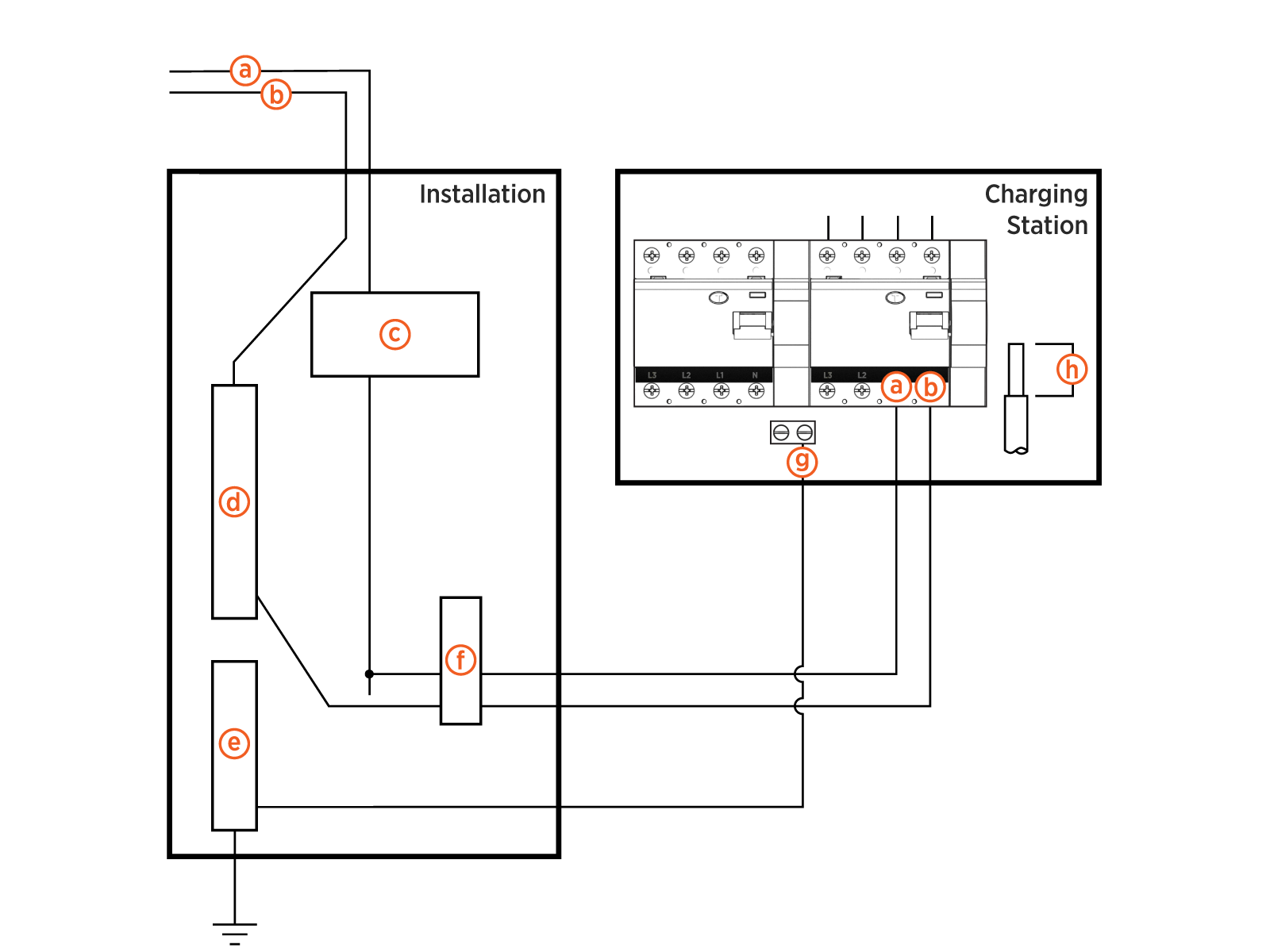
(a) L1
(b) Neutral
(c) Main breaker
(d) Neutral bus
(e) Ground bus
(f) Breaker
(g) Ground
(h) Wire strip length 12 mm (0.5 in)

Grounding Requirements
CP6000 charging stations must be connected to a grounded, metal, permanent wiring system. An equipment-grounding conductor must be run with circuit conductors and connected to an equipment-grounding terminal on the charging station.
A grounding conductor that complies with applicable codes must be grounded to earth at the service equipment or, when supplied by a separate system, at the supply transformer, or may be grounded to an earth electrode. Ensure the grounding conductor complies with all applicable codes.
Earthing Systems
TT, TN-S Terra Neutral Separate, and TN-C Terra Neutral Combined-S are supported subject to local code regulations.
Connect only to the following systems:
(a)TN-S Terra Neutral Separate 230/400 VAC, 3Ø Wye Grounded Neutral
(b)TN-C Terra Neutral Combined-S 230/400 VAC, 3Ø Wye Grounded Neutral
(c) TT 230/400 VAC, 3Ø Wye Grounded Neutral

The following earthing systems are not supported:
(d) IT - (I) 400 VAC, 3Ø Wye, Floating Neutral
(e) TN-C Terra Neutral Combined (T) 400/230 VAC, 3Ø Wye Grounded Neutral

In modes TT and TN earth systems, the ground resistance must be lower than 100 Ohms if national regulations require it. Check the national regulations to verify the maximum impedance allowed.
In TT, if the ground loop impedance cannot be lower than 100 Ohms, the local earthing resistance has to be improved by changing the existing rod or putting an interconnected extra rod.
IT installation mode is prohibited. A dedicated transformer might be used to modify the system to a TN-S Terra Neutral Separate. Check local regulations for more information.
Voltage between neutral and protective earth conductors of the installation shall not exceed 10 Vrms maximum. If above condition is not met, it is necessary to identify the origin of the fault voltage and apply a corrective measure in order to commission the EVSE Electric Vehicle Supply Equipment.
In case of TN mode, installation must be checked to evaluate upstream Neutral cut-off failure.
If complying with local regulations, multiple ground network interconnection shall be achieved to ensure that in case of PEN failure, ground remains connected to the transformer neutral via neighbor link, according to IEC 60364 § 4.41.
Always check national regulations regarding the earth system used, bonding, and limit contact voltage. For example, in the UK check the BS 7671 and in France check the NF C 17-200 and NF C 15-100 to verify whether or not they are permitted for EV Electric Vehicle charger installations. Visit UK Requirements or contact ChargePoint for more information pertaining to UK regulations.
Multiple EV Charging Stations (Fleet and Multifamily Applications)
When multiple CP6000 charging stations are connected to a common ground, the value of the ground resistance must ensure that the touch voltage will not exceed 50 Vrms in the event of a failure.
When multiple CP6000s are connected to the same power supply line, an additional local ground connection must be ensured at least every 10 outlets. The maximum resistance for each additional ground connection (taken independently) must be less than 100 Ohms.
All the ground lines must be connected to ensure a single equipotential.
EV Ready Requirements
These requirements apply only to EV Electric Vehicle Ready installations. Check the EV Electric Vehicle Ready Certification Technical Reference Document Version 1.4I for more information.
Electromagnetic Compatibility
-
Harmonic distortion and unbalancing on the supply system:
The power supply system will be compliant with standards IEC 61000-2-2, 61000-2-4 (class 2) and EN 50160 clause 4.2.4 and clause 4.2.5. Otherwise, the installation will be adapted to finally respect the standards (additional filter, different electrical connection, and the like). If above condition is not met, a transformer as defined below is to be placed upstream of the EVSE
Electric Vehicle Supply Equipment. -
Low frequency conducted disturbances on power supply system, from 0 to 150 kHz (excluding harmonics):
The noise level in the frequency band 0-150 kHz (excluding harmonics) shall not exceed 4% of the phase to neutral voltage. Otherwise, the installation will be adapted to finally respect the standards (additional filter, different electrical connection, etc.)
In case of noise emitted by domestic appliances during the charge that causes interferences with the EV Electric Vehicle, the installer may add a 10 kHz 50 dB filter upstream of the charging station to prevent excitation of the domestic electrical installation.
Installation Protection
Shock Protection
Each output of the CP6000 is protected by its own RCCB Residual Current Circuit Breaker or RCBO Residual Current Breaker with Overload Protection Type A with a maximum tripping current of 30 mA and includes protection against DC leakage current according with the applicable clauses of the IEC 62955:2018.
The CP6000 allows manual or remote tripping of the RCCB Residual Current Circuit Breaker or RCBO Residual Current Breaker with Overload Protection. A reset must be done manually. The remote reset is not allowed by the hardware of the EV Electric Vehicle charging station.
Each RCCB Residual Current Circuit Breaker complies with EN 61008-1 and EN 61008-2. Each RCBO Residual Current Breaker with Overload Protection complies with the EN 61009-1 and EN 61009-2-1.
Stations are equipped with either internal RCCBs or RCBOs. If installing additional RCCBs or RCBOs upstream, they must comply with local codes and meet the following requirements :
-
Minimum type A
-
Required minimum tripping current of 100mA or 30mA with selective tripping curve, due to 2 RCDs connected in series
-
Capacity current equal or higher than nominal current
Voltage between Neutral and Protective Earth conductors for the installation cannot exceed a maximum of 10 Vrms. If voltage exceeds 10 Vrms, identify the origin of the fault voltage and correct it before commissioning the EVSE Electric Vehicle Supply Equipment.
Secondary Tripping Protection
The CP6000 charging station includes secondary switching device protection. It is constantly monitoring voltage and current in each output. If an issue causes an undesirable voltage in the output, the CP6000 automatically triggers its internal secondary switching device. No other actions are necessary for the installation.

(a) EVSE Electric Vehicle Supply Equipment operating in Mode 3
(b) RDC-DD of type RDC-MD
(c) RDC-M-Module
(d) RCCB Residual Current Circuit Breaker Type A
(e) L1
(f) L2
(g) L3
(h) Neutral
(i) Shunt trip
(j) Diff coil
(k) Coil windings
(l) Processor
(m) Relay
(n) Relay control
Overcurrent Protection
The CP6000 charging station includes overcurrent protection which will disconnect the outlet if the current is more than or equal to 1.25 times the maximum current.
The CP6000 does not include short-circuit protection and shall be protected by a circuit-breaker installer upstream in the installation with a gauge:
-
20 A for a 16 A single- or three-phase charging station
-
25 A for a 20 A single- or three-phase charging station
-
32 A for a 25 A single- or three-phase charging station
-
40 A for a 32 A single- or three-phase charging station
-
80 A for a 63 A three-phase charging station
Each connection point might be individually protected by a miniature circuit-breaker (MCB Miniature Circuit Breaker) for short circuit protection. Visit Standard Wiring Options for more information. For this case, the jumper connection must not be installed.
The circuit-breaker curve shall be:
-
Curve B or C for single-phase charging stations
-
Curve C for three-phase charging stations
-
2 pole protection for single-phase installations
-
4 pole protection for three-phase installations
The CP6000 with RCBO Residual Current Breaker with Overload Protection includes short-circuit protection with curve C and rated short-circuit capacity of 6 kA.
The RCBO Residual Current Breaker with Overload Protection comply with EN 61009-1:2012 + A1:2014 + A2:2014 + A11:2015 + A12:2016
EN 61009-2-1:1994 + A11:199.
Transformer Installation
A transformer may be installed if:
-
The power source does not provide a neutral
-
The EV
Electric Vehicle charging stations are rated up to 32 Amps per outlet and the upstream transformer (from HV High Voltage to LV Low Voltage) is less than or equal to 100 kVA -
The ground impedance cannot be reduced according to national levels
-
The voltage between neutral/ground does not comply with local regulations and cannot be achieved by any other measure (e.g. reducing the ground impedance loop)
-
Earthing system is IT type
-
The level of harmonic distortion is over the limit and the installation does not comply with the levels according with IEC 61000-2-2, 61000-2-4 (class 2), and EN 50160 clause 4.2.4 and clause 4.2.5
-
The level of the low frequency conducted disturbance on the power supply system from 0 to 150 kHz (excluding harmonics): exceeds 4% of the phase to neutral voltage and any additional protection to mitigate this (additional filter, different electrical connection, and the like) has not solved the problem
This transformer shall be coupled in Dyn and provide an impedance-TN mode, by connecting the neutral of the secondary to the existing earth through a calibrated resistor of 100 Ohms (±10%). This resistor shall be sized to withstand short-circuit currents in coordination with protection devices like the Residual Current Circuit Breaker (RCCB Residual Current Circuit Breaker), the Surge Protective Device (SPD) and any others. In case of an installation of high complexity, the space to place an isolation transformer adequately sized for the installation shall be provided in the main electric cabinet.