Introduction
This
For full specifications and certifications for CT4000 charging stations, refer to the CT4000 Datasheet available at: ChargePoint Product Reference Documentation.
- If the charging station is not installed, commissioned, or serviced by a ChargePoint certified technician using a ChargePoint-approved method, it is excluded from all ChargePoint and other warranties and ChargePoint is not responsible.
- You must be a licensed electrician and complete training at https://www.chargepoint.com/partners/training-certification to become ChargePoint certified and to access ChargePoint's web-based installer tools or ChargePoint Installer app.
Initial Site Guidelines
ChargePoint recommends that you plan to install charging stations for 5-10% of parking spaces at commercial buildings, or 10-20% for high EV Electric Vehicle adoption areas like California. Designing electrical infrastructure to support current and future needs for EV Electric Vehicle charging helps avoid costly upgrades later as demands for EV Electric Vehicle charging grows.
Electrical Requirements
An onsite evaluation is needed to determine conduit and wiring requirements from the panel to the proposed parking spaces, construction and concrete requirements for mounting the charging stations, as well as to measure cellular signal levels and identify suitable locations for any necessary cellular signal booster equipment.
Review the CT4000 Datasheet at ChargePoint Product Reference Documentation. Each Level 2 charging port requires:
-
A dedicated single phase electrical circuit (32 A at 208/240 V).
-
A new dual pole breaker 40 A circuit breaker at the electrical panel. (Used breakers can damage equipment and cause a fire risk.)
-
Conductor wiring sized in accordance with the National Electric Code requirement for 125% capacity for continuous load for all branch circuits from panel to stations via raceway or conduit.
Consequently, a CT4000 charging station with two charge ports requires two circuits and two new dual pole 40 A circuit breakers. If power capacity is limited at a site or to reduce costs for electrical infrastructure, consider ChargePoint Power Management options for power sharing at the circuit level, panel level, transformer, or site level.
CT4000 can run on 208/240 V circuits from 20 A to 40 A and will deliver a maximum of 30 A to a vehicle. Since CT4000 supports lugs up to 16 mm2 (6 AWG American Wire Gauge), we recommend running 16 mm2 (6 AWG American Wire Gauge) wire for potential upgrade to higher power chargers in the future.
Cellular Connectivity
The CT4000 charging station needs strong cellular connectivity to allow ChargePoint to communicate with the station. A connection is needed for station owners and operators to access these features:
-
User authentication, access control, and billing
-
Energy usage reporting
-
Charging station utilization and charging session details for analytical reporting
-
Real-time charging status to drivers using the ChargePoint mobile app or web portal
-
Ability for drivers to use the ChargePoint mobile app and Tap to Charge, Apple Pay, or Android Pay on their smartphone to start and stop sessions
-
Text or email notifications to drivers when vehicle battery is full or stops charging
-
Notifications to drivers prior to pricing increases for overstay of parking at EV
Electric Vehicle spots -
Station fault alarms and remote diagnostic capability
-
Over-the-air software upgrades for new station features or enhancements
If you have preexisting infrastructure or are using your own preferred electrical contractor to prepare your site, a Site Validation by a ChargePoint Operations and Maintenance (O&M) partner is required to certify compliance with electrical specification requirements, and to ensure everything was prepared to ChargePoint specifications.
Charging Station Placement
To help minimize costs, choose station locations that are as close as possible to the available electrical infrastructure. Selecting these types of locations helps minimize long conduit and wire runs, as well as any trenching work.
Layout Considerations
When planning the layout for the charging stations, consider the following factors:
-
Identify station locations for EV
Electric Vehicle charging spots. -
To help minimize costs, choose station locations that are as close as possible to the available electrical infrastructure.
-
Consider locations where it will be easy to add future stations.
-
Consider how easily drivers can find the stations they need to access.
-
Identify suitable locations with smooth, plumb surfaces for wall mount stations or suitable floor surfaces for pedestal mount stations.
-
Determine raceway or conduit runs for electrical wiring from the electrical panel. Consider a layout to minimize linear conduit costs to all proposed EV
Electric Vehicle parking spaces. If possible, avoid or minimize trenching requirements, especially more costly trenching to run conduit under asphalt surfaces. -
Consider ADA compliance. The charging station should not block ramps or pathways and the bottom of the screen cannot be more than 48 inches above the level of the parking stall.
-
Choose adjacent parking spaces in an area with adequate lighting.
-
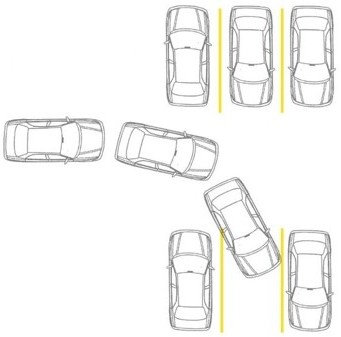
For stall parking, ChargePoint prefers using perpendicular parking stalls to better accommodate EVs with front and rear charge ports.
While ChargePoint tests charging stations with a majority of upcoming vehicles, ChargePoint cannot guarantee the port locations of future vehicles and cannot warrant the configurations proposed will work for all vehicles. -
Use dual-port pedestal mount stations where possible in open areas for adjacent parking or adjoining parking spaces.
-
Consider protective bollards and wheel blocks where appropriate, especially for open tandem parking spaces.
Electrical Considerations
When evaluating electrical requirements for EV Electric Vehicle charging stations, consider the following:
-
Evaluate existing electrical infrastructure to determine if the existing utility service and electrical panel capacity is sufficient. Ensure the electrical wiring, overcurrent circuit protection, and metering (if required) is in place by reviewing the datasheet, as well as the wiring diagram and grounding requirements in this document.
-
Ensure the electrical wiring, overcurrent circuit protection, and metering (if required) is in place by reviewing the datasheet, as well as the wiring diagram and grounding requirements in this
-
Ensure that you use 16 mm2 (6 AWG
American Wire Gauge) or 10 mm2 (8 AWG American Wire Gauge) wire to the station. If you will be feeding the station with larger wire (like 25 mm2 (4 AWG American Wire Gauge), you will need to splice the wire for 16 mm2 (6 AWG American Wire Gauge) or 10 mm2 (8 AWG American Wire Gauge). For each charging port, only three wires are required: L1, L2, and Ground. For dual port stations, only five wires are required as both ports share the same Ground wire.Neutral must be bonded to Ground upstream at the transformer or panel for each separately derived system. -
Identify costs for any necessary upgrades and/or a new dedicated electrical panel. Size all conduit and electrical wiring in accordance with the National Electric Code requirements. ChargePoint recommends using a certified electrician to evaluate available capacity and identify any upgrades that may be required.
-
If a dedicated EV
Electric Vehicle electrical panel is required, choose a panel location in close proximity to the existing electrical supply.
Additional Considerations
When planning for additional installation and operational factors, consider the following:
-
Determine appropriate mounting type: wall mount vs. pedestal mount.
-
Use dual-port pedestal mount stations where possible in open areas for adjacent or tandem parking spots. Establish the quantity of each type of charging station in the initial order.
-
Measure cellular signal levels using professional cellular test equipment to ensure adequate cellular coverage at the station installation location. To ensure adequate signal strength in underground or enclosed parking structures, cellular repeaters may be required. Use an indoor antenna located near EV
Electric Vehicle parking spaces and an outdoor antenna typically located at the garage entrance ceiling or on the rooftop where cellular signals are best. -
Determine cost budget options for electrical infrastructure to satisfy current needs and future needs. Prioritize charging stations locations based upon immediate and future needs, construction timelines, and costs.
Plan for the Future
Keep in mind not only current EV Electric Vehicle charging needs, but future needs as EV Electric Vehicle adoption grows.
-
Consider running raceway or conduit to all planned EV
Electric Vehicle parking spots, but pulling electrical wiring from the panel to meet current needs. -
Consider installing a dedicated electrical panel for EV
Electric Vehicle charging, then leverage ChargePoint Power Management to efficiently use available power at a site to support more EV Electric Vehicle charging ports than would otherwise be possible without power management.