Replace the Fan Tray Assembly
To replace the fan tray assembly, complete the following steps:
Required Tools and Materials
|
|
T25 Security screwdriver |
|
Stepladder |


Power Off the Station
Power off at the breaker panel and lock out/tag out before continuing work.
-
Before any procedure, disconnect the power. If station is paired, disconnect the power to both paired charging stations.
-
Follow local code and site lockout/tagout procedure to de-energize the station.
-
Wait for energy to dissipate (approximately five minutes).
-
Keep power off until all covers and panels are reinstalled and the work is complete.
Failure to follow these instructions can result in serious injury, loss of life, or property damage.
Remove the Fan Tray Assembly
-
Use a T25 security screwdriver to loosen the two screws that secure the top of the upper rear panel to the enclosure frame.
When replacing this panel, torque the screws to 4.5 Nm (40 in-lb).
-
Use two hands to pull the upper rear panel away from the station. Then lift it up and take it off the keyholes to remove it.

-
The system has two fan trays (left and right). On the fan tray to be replaced, pull the tab (a) forward to disengage it.
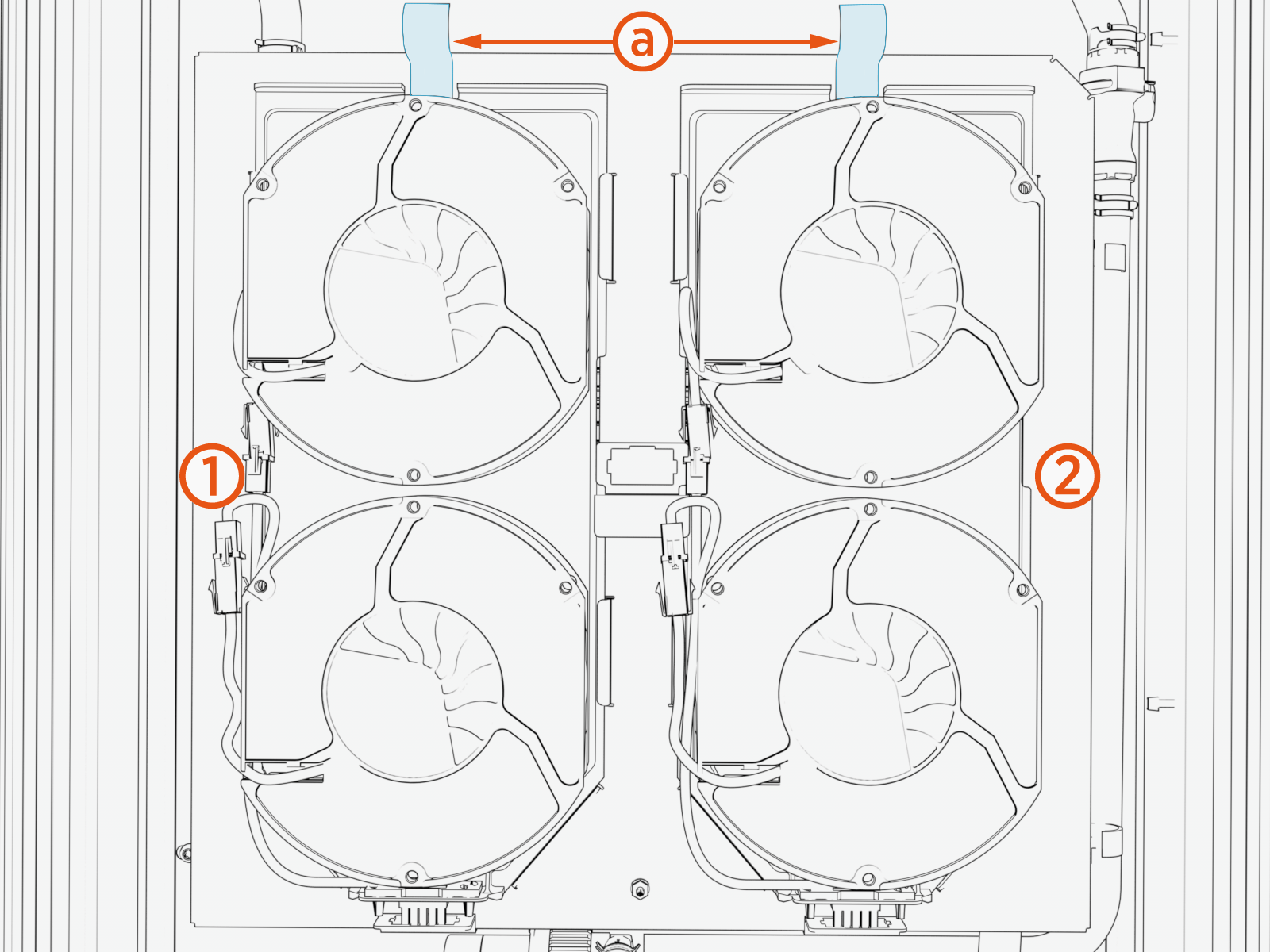
-
With both hands, slide the tray upward until the mounting tabs (b) on the fan tray assembly are positioned above their corresponding slots.
Check that the power connector at the base of the fan assembly easily disengages as the fan tray is lifted.
-
Pull the fan tray assembly toward you to remove it.
Install the New Fan Tray Assembly
REVERSE THE ABOVE STEPS TO REPLACE THE FAN TRAY ASSEMBLY AND THE UPPER REAR PANEL.
Power On the Station
Once all parts are installed, power on the Express 280. The Express 280 runs a self test to verify that it can operate properly.